
What Nietzsche Got Right
And what he missed.

A scapegoat for both “godless liberalism” and authoritarian extremes, Friedrich Nietzsche deserves a second look. What endures is not his conclusions but his method. Calling himself a psychologist of the soul, he exposed why people cling to beliefs, deceive themselves, and fear freedom—and he sought not demolition but renewal: to see through illusion to what’s real.
When Nietzsche declared “God is dead,” he wasn’t gloating; he was sounding an alarm. Only a madman in his parable grasped the danger. Without transcendence, humanity drifts toward the path of least resistance, choosing comfort over meaning.
His answer was the will to power—not domination, but life’s impulse to expand, create, and surpass what we were yesterday. Real power isn’t control over others but mastery of oneself: the capacity to take what breaks you and forge it into something that matters.
In his classic Thus Spoke Zarathustra, this vision becomes poetry. Zarathustra is a prophet of life after God, urging humanity to resist becoming the “last man”—the comfortable conformist who wants no risk, no depth, no greatness, and blinks contentedly at a world without aspiration. Against such smallness, Nietzsche set amor fati: accept life, pain included, and live as though you would choose it again. “One must still have chaos in oneself,” he wrote, “to give birth to a dancing star.”
Even Zarathustra expects his followers to outgrow him. Nietzsche isn’t telling readers what to think but how to think. His work offers not a doctrine but a discipline at the heart of being human.
Nietzsche scorned St. Paul’s spiritual pride—the genius for turning weakness into virtue and guilt into power—yet respected Jesus, who affirmed life without excuse or reward. He drew a line between contempt for the Church and esteem for the man who said yes to existence—until, he thought, Paul and the Church turned that yes into reproach.
In The Antichrist, a late and fierce work, he attacks Christian doctrine with startling intensity. The son and grandson of Lutheran pastors, he sounds like Luther in reverse. Yet in the midst of the assault, he pauses: he dislikes Christians, he says, but admires Jesus.
For Nietzsche, Good Friday was not about sacrifice or guilt. At its core, it was about love. The cross was not appeasement of an angry God; it was freedom from fear—a life lived so fully that even death became an expression of love.
Here he found unexpected common ground with Ralph Waldo Emerson. The divine, for both, was immanent—a presence in the world, in relationships, in flesh. Emerson’s “Over-Soul” and Nietzsche’s “divine humanity” shared a belief that life itself carries the sacred. What the Church externalized in doctrine, both sought to reclaim as experience.
Nietzsche argued that traditional atonement theology (the view that God demanded Christ’s suffering as payment for sin) led believers away from love by fixating on punishment—an instinct Jesus never shared. The impulse to punish, he said, springs from ressentiment: the wish to harm while calling it justice.
Jesus’s example became a religion of guilt. At the cross, his followers looked for someone to blame. Jesus blamed no one. His first words were forgiveness.
The Church, Nietzsche thought, could not follow him there. When hatred could not turn outward, it turned inward—believers taught to feel guilty for killing God. Piety became self-punishment disguised as devotion.
To Nietzsche, this was betrayal. The man who forgave his killers was remade into a victim demanding payment. Love became guilt; unity became division. Jesus, he wrote, lived the unity of God and humanity as his good news. The belief that God required his Son’s death for forgiveness led Nietzsche to conclude the Gospel had been lost.
For Nietzsche, the crucifixion revealed a life freed from fear—love so unguarded that even death could not diminish it.
Such a vision changes how we see one another. If divinity can dwell in flesh of our flesh, bone of our bone, then no life is trivial. The ethical consequence follows: to love, rather than resent, our fellow material beings—including ourselves. To love them is to honor the God who took form in flesh. Theologically speaking, creation promised redemption; in Jesus, that promise awaits recognition.
This dissolves pride and despair alike. Love—not resentment—is the meaning of following Christ. Even Nietzsche’s fiercest critique ends as a summons: return to the center.
What Nietzsche missed wasn’t faith in Jesus but the faith of Jesus: his trust in God. Jesus embodied something Nietzsche could not accept—the surrender of self to a greater power. Even facing crucifixion, he prayed: “Not my will, but thine be done.”
The cross declares what Emerson saw and what Nietzsche, for all his protests, could not deny: divinity is not only elsewhere but here, in flesh.
God is with us—still. Believe it or not.
Notes and reading
Jesus—“You did not say you were the answer,/ You said you were the way…” —from a prayer of the ecumenical Iona Community, a favorite of founder George MacLeod. The Beginning of Wisdom: Prayers for Growth and Understanding—Thomas Becknell (1995), 96.
Death of God—Nietzsche’s “death of God” names not a theological denial but a cultural fact: the loss of belief in any transcendent source of truth or value that once grounded life.—The Gay Science §§108–109, 125; Thus Spoke Zarathustra, Prologue §3; On the Genealogy of Morality III §27.
Will to power—Nietzsche rejects “life force” metaphors that treat vitality as a hidden substance. For him, “life” itself is interpretation, not a mystical energy behind it.
—Beyond Good and Evil §36.
Reason and revelation—Reason is still faith. It seeks not truth but refuge—deliverance from chance. Revalue this will to truth as the will to power: to make it serve life instead of mistaking itself for life’s highest good.—The Gay Science §§335–336, 344.
Morality—Nietzsche does not deny that some acts harm and others help. We still need distinctions, he says, but should draw them from the flourishing of life rather than obedience to dogma.—Daybreak §103.
Friedrich Nietzsche—Lou Andreas-Salomé (1894; English 1988). An intimate portrait. Salomé was a free-thinking Russian-born philosopher, writer, and the first female psychoanalyst—a femme fatale in intellectual Europe, impossible to ignore. Despite her open relationships, her marriage endured. Nietzsche felt an intense closeness with her and proposed marriage, but Salomé, deeply drawn to Nietzsche, loved a younger man—Rainer Maria Rilke. She became Rilke’s lover, mentor, and muse. Freud, not a lover but an admiring ally, regarded her as the most perceptive analyst of her generation.
Nietzsche considered “Lou” the most significant person in his life—the emotional and intellectual force shaping both his work and his world.
—Selected Letters of Friedrich Nietzsche, ed. and trans. Christopher Middleton (1969), 157–163.
Theological note—For rigorous engagement, see David Bentley Hart, The Beauty of the Infinite (2004), 93–124. Hart takes Nietzsche’s “will to power” seriously—now virtually the modern worldview—and reframes Nietzsche’s genealogy of nihilism rather than rejecting it. For Hart, Nietzsche is the thinker in whom theology confronts its most formidable challenges—ancient, modern, and postmodern—even as his rejection of transcendence ultimately narrows his vision. (Elsewhere, Hart—at peak humor—dismisses the now-waning “New Atheists”: Richard Dawkins, Sam Harris, Christopher Hitchens, and Daniel Dennett.)
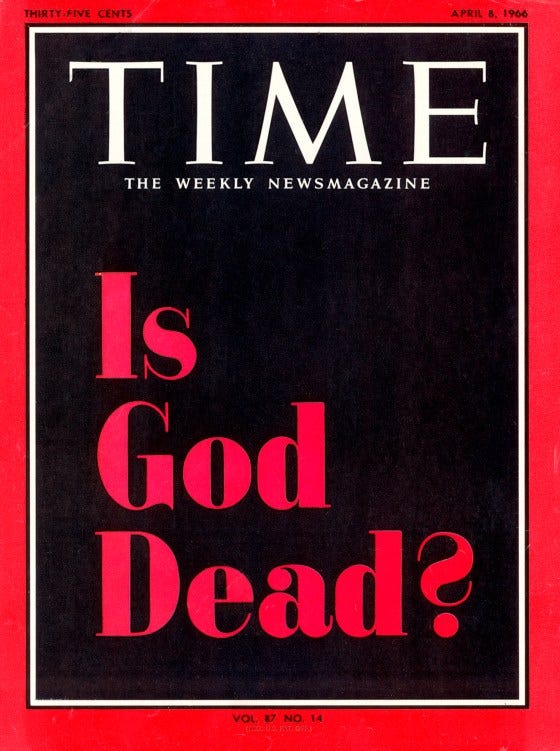
Thank you for what is for me a reintroduction to Nietzsche, whom I haven't seriously read since college. Your comparison of him with Whitman was particularly helpful. When I first read Nietzsche in college and for two decades thereafter, I saw him as most other American Evangelicals who knew of him probably did--as some kind of uber-atheist. I think I began to understand his "God is dead" about the same time that I began to understand John Lennon's remark (made the same year as Time's publication of its famous "Is God Dead?" issue) about the Beatles being more popular than Jesus. Each in his own way was sounding an alarm.
I must say, these days I understand Jesus' crucifixion more in line with how you describe Nietzsche's understanding of it than how you describe Nietzsche's take on how the church in general understands it. (Pardon my syntax!)
I look forward to reading Hart on Nietzsche as well as Donald Wallenfang’s Phenomenology: A Basic Introduction in the Light of Jesus Christ mentioned in Eric's post on Nietzsche and Husserl.
Yes, great piece and I agree! “What endures is not his conclusions but his method. Calling himself a psychologist of the soul, he exposed why people cling to beliefs, deceive themselves, and fear freedom—and he sought not demolition but renewal: to see through illusion to what’s real.”