
The Purple Goddess
Faith confronts politics by refusing to belong to it.

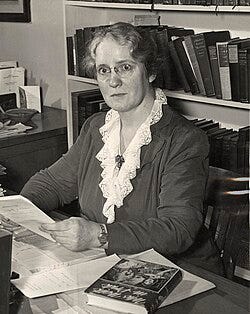
Monday’s post asked what kind of country memory is meant to make. This one follows with the second half of the question: what kind of faith can make that memory endure? The guide here is unlikely, nearly forgotten, and, as it turns out, timely.
Faith goes wrong fast when it becomes politically convenient.
The current fashion for Christian nationalism comes with the usual accessories: flags, slogans, bad history, and the comforting thought that the gospel would be easier to understand if it were a political program. Jesus would have been easier to classify had he come to overthrow Rome. But he would not have been crucified had he failed to threaten it.
When we think of faith and politics at their best, the names are familiar: Martin Luther King, Nelson Mandela, Desmond Tutu, the Dalai Lama. They understood that spiritual seriousness does not withdraw from politics, but refuses to be swallowed by it. Their greatness lay in that difficult balance.
Helen Constance White is not a figure of that scale, and the comparison would be absurd if it rested on fame or historical consequence. But she belongs in the same moral conversation: how faith can stand within political crisis without becoming politics by other means.
I had not expected Helen Constance White to enter this company. A scholar of mysticism and literary imagination, she is not usually placed there. Born in 1896, she became a major Catholic literary scholar and writer, the first woman to become a full professor in the College of Letters and Science at the University of Wisconsin–Madison. She wrote on devotional literature and the metaphysical poets, produced historical fiction shaped by Christian conscience under pressure, and received two Guggenheim Fellowships and Notre Dame’s prestigious Laetare Medal, presented annually to an American Catholic "whose genius has ennobled the arts and sciences, illustrated the ideals of the church and enriched the heritage of humanity."
I came to White late, which may be the right way to meet her. Obscurity has spared her the indignity of being turned into another slogan. White’s learned historical novel To the End of the World unfolds amid the French Revolution and becomes more than a story of persecution and fidelity. Politics lays down its terms: surrender the inward life or be treated as an enemy of history.
Its central figure, Michel de la Tour d’Auvergne, is no simple enemy of reform. He can honor the Revolution’s promise and still refuse its demand that the Church, conscience, and the inward life submit to the state. As the Revolution hardens into terror, Michel’s vocation is stripped of romance. The abbey of Cluny is broken up. Priesthood becomes fugitive, practical, and dangerous. The public drama of history turns intimate: family, fear, loyalty, sacrament, and conscience all come under pressure.
The setting is historical; the temptation is not. Every age produces disillusioned strivers, contemptuous of what formed them and hungry for an ideology large enough to replace it. White saw how quickly moral language can become permission. The state need not silence conscience when it can make it sound like loyalty.
Given the patriotic and pietistic abuses of Jesus’s name, and the faith now performed from Washington with growing frequency, White becomes another voice for religion true to itself. She rejects the liberal habit of shrinking faith to ethics or enlightenment, and the conservative habit of shrinking it to order, inheritance, or national destiny. Against the newly fashionable recidivism that treats church-state separation as a mistake, she spares us the caricatures.
White recalls what Jesus is about: not the overthrow of Rome or a republic draped in piety, but the promise and demands of God’s kingdom among persons no state can possess.
“My kingdom is not of this world,” Jesus said. He did not say it was not for this world. His kingdom does not ignore politics; it denies politics any claim to ultimacy and subjects it to God’s judgment and mercy.
Faith does not dispense with prudence, law, courage, or compromise. But it forbids politics from becoming ultimate. Immigration, gender, and belonging—who counts as one of us—are more than disputes over law and policy. They are where the state’s necessary power meets both the person it must never possess and the truth by which it is judged. White’s own life bore this out: she helped lead a lay movement defending the separation of church and state and openly opposed Senator Joe McCarthy during the Red Scare.
White’s students nicknamed her “the Purple Goddess,” partly because of her devotion to purple clothes. She made no apology for the habit: “When I fly off for a weekend engagement, everything matches automatically.” The “goddess” part may also have had something to do with her height. She stood over six feet tall, though the photograph above keeps that grandeur behind a desk.
Charming aside, purple is the right color: majestic, even royal, on No Kings Day. White writes about the dignity power forfeits when it treats conscience as a threat and integrity as disloyalty.
Faith may judge politics, but not become its mascot. Politics may govern, but not decide what a person is worth. Her witness is an abbey under siege: memory, worship, conscience, justice, and mercy held together when the age demands surrender.
Amen.
Notes and reading
Helen C. White, To the End of the World (1939). White’s historical novel is out of print in its original edition, though it may be borrowed digitally through the Internet Archive's Open Library with a free account when lending access is available; recent paperback reprints also circulate through booksellers.
For more background on White, see “Helen C. White,” Cluny Media, and “A Priest to Face the Revolution,” The Imaginative Conservative (May 23, 2026). For White’s activism, including her church-state work and opposition to McCarthy, see her obituary in The Capital Times (Madison, Wisconsin, June 8, 1967).
Dorothy Day helped sharpen White’s modern relevance. In 1962, Day wrote that White “confessed to me that she wrote it for our time.” Day read the novel as a contrast between clergy who flee and seek armed intervention and those who stay, go to prison, and continue learning, suffering, and serving. White’s novel is not royalist nostalgia but a warning against faith that seeks safety through force. —Dorothy Day, “More About Cuba,” The Catholic Worker (July 1, 1962).
Willa Cather’s Death Comes for the Archbishop (1927) and Graham Greene’s The Power and the Glory (1940) are useful comparisons. Cather is concerned with Catholic life taking root; Greene, in an anti-clerical persecution novel, with grace working through a compromised “whisky priest.” White’s concern is the Church under pressure: divided, endangered, and forced to decide how to remain faithful when politics demands submission.
John J. DiIulio Jr., “Religious Freedom: The Foundation of Liberal Democracy” (Religious Freedom Institute, 2016). DiIulio, a Penn political scientist and former Princeton professor who has worked across partisan lines, treats religious freedom not as a private preference or sectarian claim, but as one of the disciplines that keeps liberal democracy honest: the state must make room for conscience without claiming ownership of it.
Robert Audi, Religious Commitment and Secular Reason (2000). Audi, the Notre Dame philosopher, argues not for excluding religion from public life but for civic restraint: faith may shape public argument without becoming state coercion. Also, Is This God’s Country?: Religion and Democracy in America (2024).
Addison Hodges Hart, The Pragmatic Mystic. Hart’s phrase is useful here because it refuses the false choice between contemplation and practice. A retired priest and writer on spirituality, Scripture, and art, Hart treats mysticism not as escape from the world but as clearer sight within it. A good companion to White: inward depth is tested not by withdrawal, but by fidelity under pressure.
Simone Weil, Waiting for God (1951; also published as Waiting on God): “To be always relevant, you have to say things which are eternal.” The line captures White’s kind of relevance: not keeping up with the moment, but staying faithful to truths politics is always tempted to misuse. See also Weil’s The Need for Roots.