
Martyrs of Memory
Hidden no more.

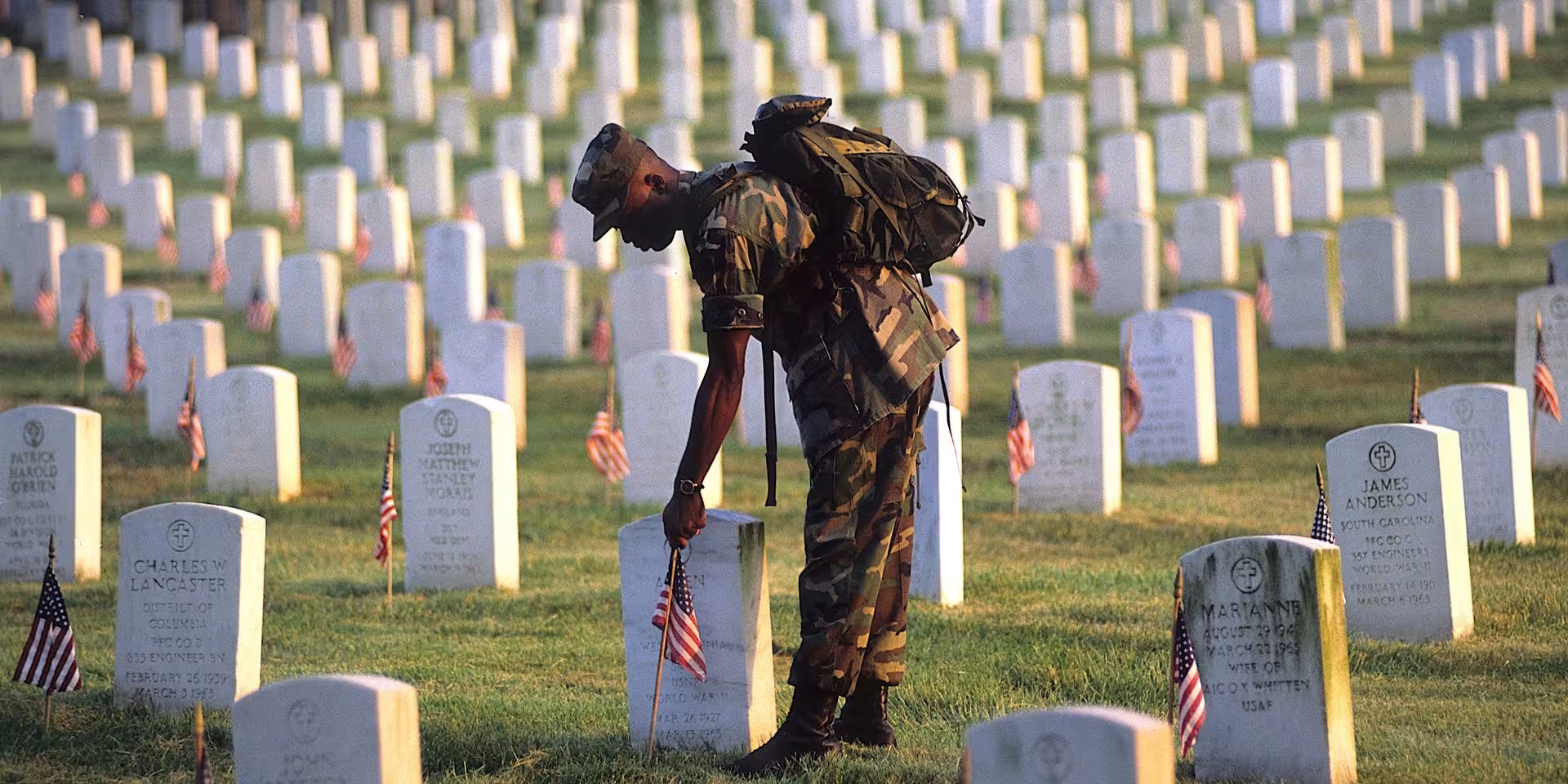
At 3:00 p.m. local time today, Americans are asked to pause for a moment of remembrance.
Memorial Day stirs mixed feelings about patriotism and America. Love of country and gratitude for those who died in its service can get lost amid anger over what the country has become, or exhaustion over what it still refuses to face. For what were those sacrifices made? The day raises that question. It asks what kind of country memory is meant to make.
The origins of Memorial Day reach back to the Civil War, which claimed roughly 620,000 American lives, more than any other war in the nation’s history. If the same share of Americans had died in Vietnam, the Vietnam Veterans Memorial would bear about four million names, not 58,000.
How should Americans remember the dead of a war fought against one another? Walt Whitman caught the burden in a single phrase: “the dead, the dead, the dead—our dead—or South or North, ours all.”
Yet one part of this history was long pushed to the margins. More than 180,000 African American men served in the United States Colored Troops. At the beginning of the war, neither the United States nor the Confederacy accepted Black men as soldiers. In the South, enslaved people were forced to dig trenches, build fortifications, labor in hospitals and factories, and drive wagons. As Union armies occupied Southern territory, formerly enslaved people were often put to the same work.
That changed in 1862, when Congress authorized the enlistment of Black soldiers. Even then, they served under white officers, faced contempt from many white Union troops, and were often treated more as laborers than soldiers. Some blamed them for the war itself. They endured danger from both sides: Confederate fury and Northern prejudice. Yet as they fought, and as their courage became undeniable, they forced recognition from those who had doubted them.
The earliest and most remarkable Memorial Day observance took place where the war began.
In the spring of 1865, Charleston, South Carolina, lay in ruins after siege and bombardment. The city where secession had begun was now occupied by Union troops. Among the first soldiers to enter Charleston, marching up Meeting Street and singing liberation songs, were men of the 21st United States Colored Infantry. Their commander accepted the city’s surrender.
Most white residents had fled. Thousands of Black residents, many formerly enslaved, remained. They understood the war with a clarity others would later obscure. They held commemorations of victory and sacrifice.
During the final year of the war, Confederates had turned Charleston’s Washington Race Course and Jockey Club into an outdoor prison for Union captives. The prisoners were kept inside the track. At least 257 died of disease and exposure and were buried behind the grandstand.
After the Confederate evacuation, Black workmen went to the site, reburied the Union dead, and enclosed the cemetery with a whitewashed fence. Over the entrance, they built an arch and inscribed three words: “Martyrs of the Race Course.”
On May 1, 1865, thousands gathered there. The procession was led by 3,000 Black schoolchildren carrying roses and singing “John Brown’s Body.” Several hundred Black women followed with baskets of flowers, wreaths, and crosses. Black men marched behind them, followed by Union infantry. Inside the cemetery, a Black children’s choir sang “We’ll Rally Around the Flag,” “The Star-Spangled Banner,” and spirituals. Black ministers read from Scripture.
It was remembrance, but also declaration. The neglected would be honored. The hidden would be named as martyrs. The war had been fought over slavery, and the first great ritual of national mourning was shaped by those who knew what emancipation had cost.
Memorial Day did not begin only as a custom of flags, flowers, and graves. It began as an act of moral clarity. The formerly enslaved honored the Union dead because memory is never neutral; it tells a country what it has suffered, what it has done, and what it must not forget.
After the dedication, the crowd entered the infield for picnics, speeches, and drills. Union infantry took part, including the 54th Massachusetts and the 34th and 104th United States Colored Troops, marching around the graves.
The war had ended, and Memorial Day had begun in an act of remembrance and consecration led by African Americans. Its meaning was plain: emancipation, not the slaveholders’ republic, had claimed the nation’s future. They were the patriots.
Frederick Douglass gave words to that claim in an 1878 Memorial Day speech in New York City. The war, he said, was not merely “sectional,” but “a war of ideas, a battle of principles”—“slavery and freedom” in conflict, fought for “something beyond the battlefield.”
That “something” remains the question Memorial Day asks.
Lest our feet stray from the places, our God, where we met Thee,
Lest our hearts, drunk with the wine of the world, we forget Thee;
Shadowed beneath Thy hand,
May we forever stand,
True to our God,
True to our native land.
—James Weldon Johnson, “Lift Every Voice and Sing”
Notes and reading
James McPherson, Battle Cry of Freedom: The Civil War Era (1988) and The War That Forged a Nation: Why the Civil War Still Matters (2015)—the first remains the classic one-volume account of the war’s causes, course, and consequences; the second offers a shorter, later argument for why the Civil War still shapes American disputes over union, liberty, race, citizenship, and national purpose.
Heather Cox Richardson, How the South Won the Civil War: Oligarchy, Democracy, and the Continuing Fight for the Soul of America (2020)—Richardson, a Boston College historian and author of Letters from an American, argues that the Confederacy’s anti-democratic habits endured, moving westward and reappearing in later fights over race, labor, democracy, and power.
David Blight, American Oracle: The Civil War in the Civil Rights Era—a study of Civil War memory during the civil rights era, centered on Robert Penn Warren, Bruce Catton, Edmund Wilson, and James Baldwin, four writers who asked what Americans remembered about the Civil War, and what they preferred to forget.
“United States Colored Troops”—American Civil War Museum. The formation and experience of the USCTs. Black soldiers’ path from exclusion and forced labor to enlistment, discrimination, combat service, and recognition.
“Service, Sacrifice, and Citizenship: Ballot Blocked Episode 1”—National Park Service (June 11, 2021). On Black military service, family sacrifice, and citizenship before the vote, including how African American women supported USCT soldiers and claimed public belonging in a nation that denied them full citizenship. Enslaved people and freedmen also aided Union forces with knowledge of Southern terrain and Confederate movements. Harriet Tubman served in South Carolina as a Union nurse, scout, and spy, and helped lead the Combahee River Raid, which freed more than 700 enslaved people.
Another passed-over fact. Foreign-born immigrants made up about 25 percent of those who served in the Union Army and Navy during the Civil War. — “Who Fought?” American Battlefield Trust (November 15, 2024).
Habits of forgetting—Jonny Thomson, Big Think, May 19, 2026. “Dead closures”: inherited ways of seeing that harden into unexamined judgment. Nations inherit not only memories but habits of forgetting. The moral task is to notice which past has claimed our vision before deciding what deserves honor.
James Weldon Johnson’s “Lift Every Voice and Sing” (1900), set to music by his brother J. Rosamond Johnson, became known as the Black national anthem and was adopted by the NAACP as its official song in 1919.
AI, originality, and the new bilingualism—Intelligence, Cracked-Up