
What Is Not
Some truths begin by refusing what is false.

The world is not waiting to be explained away. Not everything explained has been understood. Perhaps truth depends as much on knowing what is not true as on knowing what is.
Because I’m a preacher by trade, I’ve grown suspicious of explanations that make the world feel smaller. Too many answers leave the world less alive than they found it. [*]
For many nineteenth-century thinkers, “God,” “History,” or “Progress” guaranteed that suffering was not meaningless. Hegel, Marx, and some religious thinkers, in very different ways, imagined individual loss as part of a larger movement toward reconciliation, liberation, or divine purpose. The cost was high: actual suffering could be absorbed into a story promising vindication in the end.
For many twentieth-century thinkers—and still now—“the market” or “technology” became the new safety net. Global trade, economic growth, digital speed, and now AI promise rescue from limits we no longer know how to accept. Optimists call hollowed-out communities, climate damage, and loneliness “growing pains.” Pessimists do their part too: predict the worst often enough, and someone will mistake you for a prophet.
In both cases—and throughout modern thought since the scientific revolution and the Enlightenment—reality is often reduced to a material foundation. Even God and consciousness become products of particles, chemistry, brain states, and social conditions—effects to be explained away.
Yet this rigid materialism has hit a wall. To explain how a physical brain can feel anything, philosophers are revisiting panpsychism and related theories of mind. The old assumption that mind is a late byproduct of matter no longer feels secure.
Scientific naturalism is expanding its understanding of matter, opening the possibility that matter has a presence of its own.
This irony is no longer confined to seminar rooms. In A World Appears: A Journey into Consciousness, the author and journalist Michael Pollan brings his familiar curiosity to consciousness itself, moving among neuroscience, philosophy, literature, spirituality, psychedelics, AI, and plant life.
Drawing on plant behavior and the limits of machine intelligence, Pollan presses a question the mechanical worldview cannot easily answer. Where does awareness begin, and what forms might it take? Trees, flowers, rodents, and even pests need not be humanlike to unsettle the assumption that nature is mindless.
A cultural shift is underway. Just as we realize our smartest computers cannot feel, we are beginning to wonder whether the natural world we dismissed as mindless was ever as mute as we imagined.
Literature has long known how to notice what systems miss. Willa Cather was captivated by the mystery of the Southwest and resisted “East Coast standards” that, in her view, replaced the humane and particular with something colder and manufactured. In Death Comes for the Archbishop (1927), she hoped to preserve a spirit already becoming fragile. The novel became, among other things, a literary act of preservation.
That awareness of loss complicates the jealousies of “progress” at the heart of cultural division. “Only connect,” wrote E. M. Forster, another novelist suspicious of modern fragmentation. The phrase now risks becoming a slogan for the wellness industry, which manufactures connection as positive thinking. In Cather’s hands, connection is not a mood. It is fidelity to what might disappear.
The irony is that this language of connection now returns not only through literature and memory, but through the strangest reaches of science itself. Non-locality and entanglement do not prove God, prayer, or transcendence. But they do unsettle the older picture of reality as a sealed machine made of isolated parts.
That possibility matters for “intercessory prayer.” If reality is more deeply connected than the mechanical imagination allowed, prayer need not be a cry into the void. It may be an alignment with a responsive fabric of being, where a movement of the heart here resonates more widely than we can measure.
My prayers for you and yours for me may actually matter, carrying weight in our lives and a presence in the structure of things.
In approaching these mighty matters, asking what is not true becomes clarifying. It clears away idols that make a mechanical universe feel inevitable.
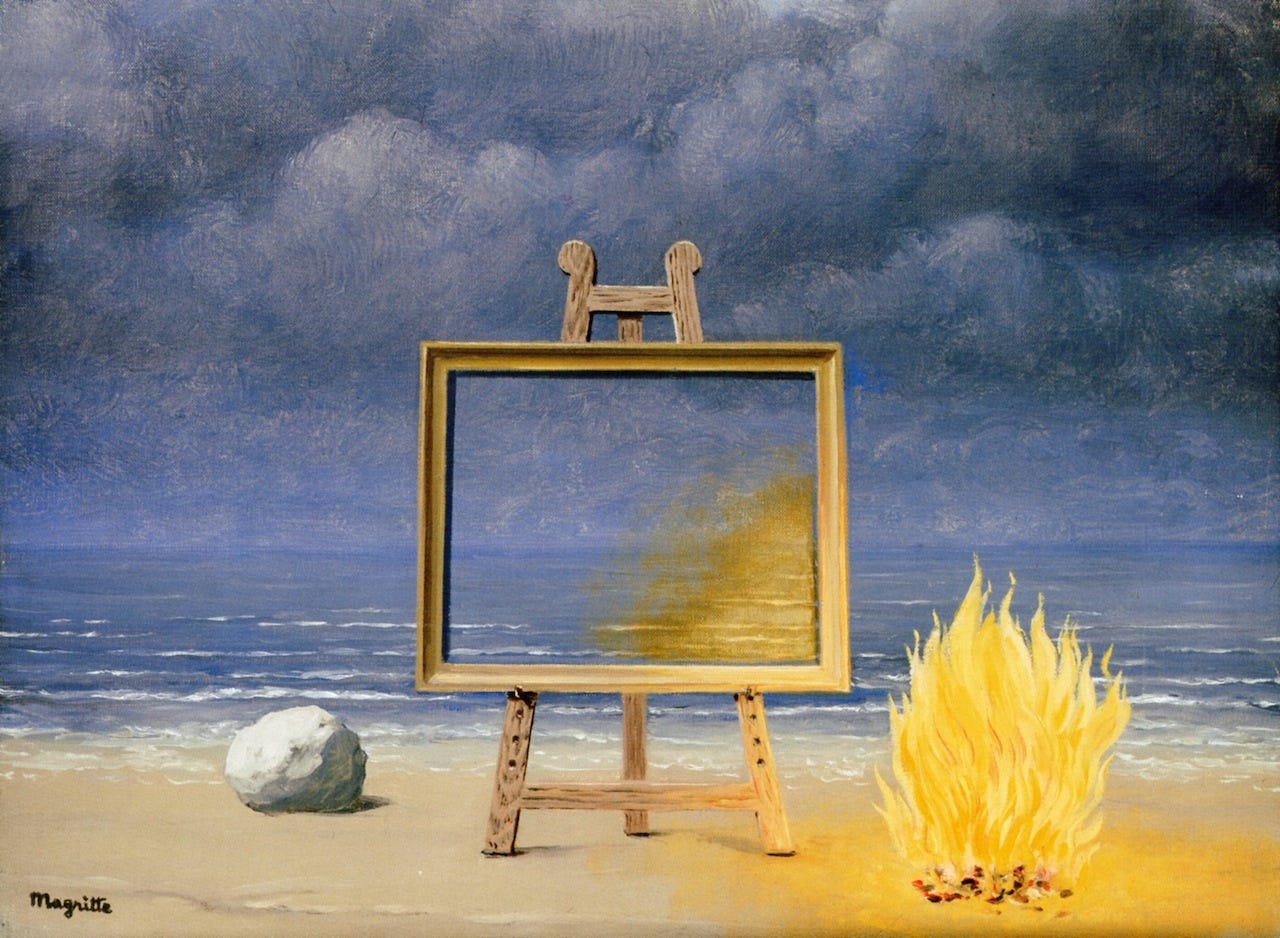
This is the riddle of René Magritte’s La belle captive, a painting about looking itself. While the frame suggests reality, the image shows how easily appearance hardens into certainty. The danger is not ignorance but a mistaken idea passing for knowledge.
As Iain McGilchrist, a philosopher and critic of modern reductionism, suggests, this hardening is a danger of left-brain dominance. We mistake flat representations, definitions, and simplified maps for the living world. We become prisoners of the frame, forgetting that the model is never the reality it attempts to contain.
Scripture itself makes room for this refusal of easy certainty. Job demands answers. Ecclesiastes gives voice to weariness and disillusionment. Thomas doubts; Jacob wrestles; Peter fails. Faith was not meant to be merely inherited. It was meant to be tested. Not destroyed. Not abandoned. Tested.
Early mystics knew that the closest we get to the Divine is often by stripping away small certainties. Wisdom begins by respecting ignorance. Breaking free from a flattened view of reality does not require a new dogma. It requires the willingness to say no to any account of the world that diminishes it. As Gregory of Nyssa wrote, “This is the true knowledge of what is sought; this is the seeing that consists in not seeing.”
This negative approach brings stark clarity. No scientific proof or finished theology is required to know the reality of a living forest, or the truth of a prayer.
We simply have to look at the promises and pretenses of our age and say confidently: this is not all there is.
In that honest refusal, the world comes alive again.
Notes and reading
[*] Herman Melville worried about this. In a June 1851 letter to Nathaniel Hawthorne, he caught the difficulty with humor: “I am falling into my old foible—preaching”; a few lines later, he added, “Try to get a living by the Truth—and go to the Soup Societies.” The letters collected in The Divine Magnet: Herman Melville’s Letters to Nathaniel Hawthorne (2016) show Melville at his most searching, excessive, comic, and spiritually restless. Hawthorne described Melville’s mind as wandering over “deserts, as dismal and monotonous as the sand hills,” adding that “he can neither believe, nor be comfortable in his unbelief; and he is too honest and courageous not to try to do one or the other.”
“Every definitive statement about the universe is a mask worn by our ignorance.” Owen Barfield has become a revelation to me: a strange and lucid guide to how perception becomes belief. A friend of C. S. Lewis and J. R. R. Tolkien, Barfield argued in Saving the Appearances: A Study in Idolatry (1957) that idolatry is not only religious. Ideas, images, and explanations become idols when mistaken for reality itself.
“Theory of everything”—in physics, the phrase names the hope for a single framework uniting the fundamental forces of nature. The title also echoes The Theory of Everything (2014), the Stephen Hawking film, where the dream of a final equation meets love, frailty, and the excess of life over explanation.
Taylor Dotson, The Divide: How Fanatical Certitude Is Destroying Democracy (2021)—Political polarization is driven not simply by disregard for facts but by an obsession with truth hardened into certitude. Cf. Jonathan Sacks, To Heal a Fractured World: The Ethics of Responsibility (2005), on faith as the discipline of living with uncertainty.
Ian Buruma, “What Would You Have Done? The Morally Compromised Individuals Who Allowed the Nazis to Rise,” New Statesman (May 8–14, 2026)—Buruma’s warning is not that Weimar Germany offers an easy parallel to the present. It is that democracy can fail when competing certainties make a common political world impossible. The Weimar Republic was crippled by radically different ideas of the state, and too few people were prepared to defend the fragile republic they actually had. Too many preferred the state of their dreams to the republic in front of them.
Max Weber, “Science as a Vocation” (1919) and The Protestant Ethic and the Spirit of Capitalism (1905)—The modern world does not simply lose belief; it learns to organize life as calculation, method, and control. The cage becomes rational before it becomes iron. Kafka put it perfectly: “A cage went in search of a bird.”
Michael Pollan, A World Appears: A Journey into Consciousness (2026)—Pollan brings the mystery of consciousness into public view, moving among neuroscience, philosophy, literature, spirituality, psychedelics, plants, and AI. He does not solve the problem; he helps restore its depth.
Willa Cather, Death Comes for the Archbishop (1927), and E. M. Forster, Howards End (1910)—Cather’s Southwest novel is not nostalgia but preservation: an attempt to honor a particular spiritual and cultural world before imported standards of progress flattened it. Forster’s “Only connect” remains one of the great modern appeals against fragmentation. In both writers, connection is not sentiment but fidelity to what might disappear. Cf. Shakespeare’s The Winter’s Tale, where loss, estrangement, time, and reconciliation come together in the hope that what seemed lost may yet be restored; and the parable of the Prodigal Son, where what seemed lost is restored through welcome rather than explanation.
Jeffrey Koperski, “Quantum Mechanics and Theology,” St Andrews Encyclopedia of Theology (2026)—A recent scholarly overview of how quantum theory has entered theological reflection, especially debates over indeterminacy and the limits of mechanistic explanation. The danger is easy metaphor; the possibility is renewed humility before a reality stranger than mechanism.
Iain McGilchrist, The Master and His Emissary (2009) and The Matter with Things (2021)—McGilchrist’s account of divided attention helps explain the captivity named in this essay: the left hemisphere grasps, fixes, maps, and controls; the right remains open to presence, relation, and living reality. The danger is not analysis itself, but analysis enthroned. The map is useful until it starts correcting the landscape.
René Magritte, La belle captive (1950)—The frame suggests reality; the image unsettles the suggestion. The reflected fire sharpens the warning: appearance can harden into certainty, but it can also disclose a first truth: this is not all there is. Reality resumes when certainty fails.
Intelligence, Cracked-Up—AI, originality, and the new bilingualism
Three of my favorite lines from your wise article’s flashing yellow lights:
"Too many answers leave the world less alive than they found it."
"Wisdom begins by respecting ignorance."
"No scientific proof or finished theology is required to know the reality of a living forest, or the truth of a prayer."
You establish, I think, that the strait path is for us the dark path. On it, Ignorance is respected and answers are questioned. Testing, being tested, doubting and saying no--even when it means another not yet to yes—our vita on the via negativa.
You demonstrate that materialism’s explanations and framing override, at turns, both hope and the despair that can begin to forge hope into an anchor.
Your call to see what is not for what it is brings to mind one of my favorite passages about light and darkness (Isaiah 50:10-11 REB):
“The one who walks in dark places with no light, let him trust in the name of the Lord and rely on his God. But all who kindle a fire and set firebrands alight, walk by the light of your fire and the firebrands you have set ablaze. This is your fate at my hands: you shall lie down in torment.”