
Intelligence, Cracked-Up
AI, originality, and the new bilingualism.

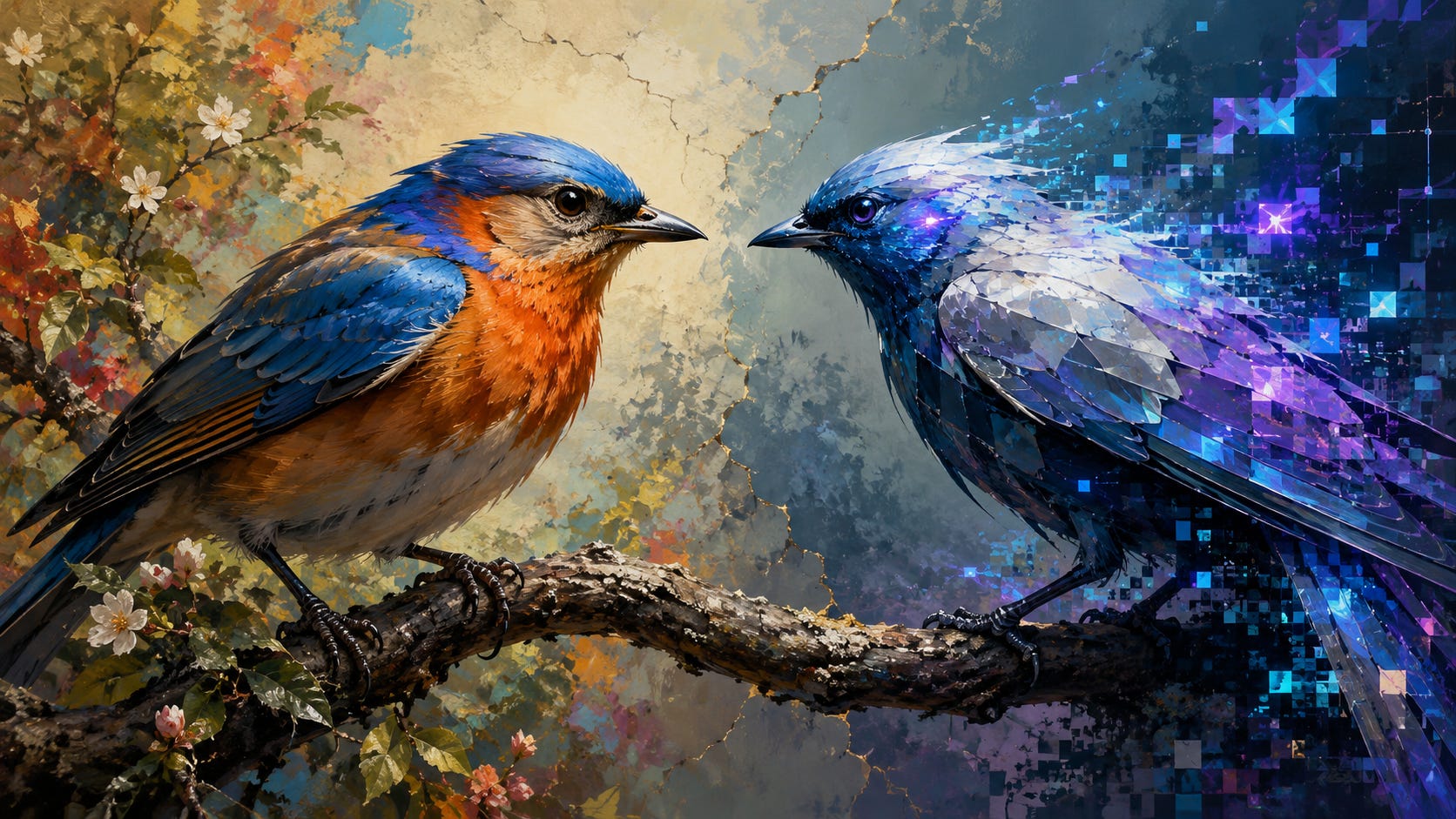
A follow-up to the last post, “Crack-Up.”
Writing about AI today feels like showing up late to a crisis that already has committees. It makes sense to begin with literacy, not predictions.
Literacy is a hidden force behind many of today’s public crises, including racism, sexism, violence, and now the rise of technology.
Intelligence is divided between people and machines. Education is becoming more personal, blended, and digital. Still, growing up with phones and tablets doesn’t mean students understand the systems shaping their learning and work.
Being fluent in one system often reveals where another falls short. If you know only one language, you might speak it well but miss its patterns—what it reveals, hides, or makes hard to say. The same applies to religion. Learning another tradition can help you see your own beliefs more clearly. As Max Müller, a pioneer in comparative religion, said, “He who knows one, knows none.”
AI works similarly. It doesn’t take the place of human literacy, just like learning about other religions doesn’t replace faith. Instead, it shows us which human skills are still essential: judgment, focus, patience, taste, conscience, and responsibility.
A good example comes from the Plains Indian tradition of “counting coup.” Honor came from touching an enemy and escaping safely, not from killing or defeating one. It was courage without conquest: skill, self-control, and calm under pressure, frustrating the adversary while ennobling the warrior.
AI literacy fits this tradition—not about controlling the machine or letting it control us, but about using it while staying in control of ourselves.
Universities can help students move from digital natives to capable digital adults. They understand AI and technology but can still think, judge, write, listen, argue, imagine, and take responsibility as humans. This matters not just for young people but for anyone living in a world shaped by digital systems.
Many critics, especially social psychologists, are quick to deplore AI’s influence. Many programs tell people to avoid it. But trying to avoid AI works about as well as eating only celery to lose weight or joining a gym out of guilt.
The idea of “originality” is a modern form of pride. The literary critic Harold Bloom argued years ago that creativity comes from the “anxiety of influence.” Whether we notice it or not, we find our own voices by first wrestling with the voices of others.
Influence doesn’t stop originality—it makes it possible. Shakespeare didn’t invent tragedy from nothing; he took old stories and made them his own. Jazz musicians learn classic songs before they change them. Painters study great artists before finding their own style. Even rebels need something to push against.
Bloom’s own ideas show this is true. His theory of originality draws on classical rhetoric, Romantic poetry, and Freudian psychology. Even a theory about how writers break free is shaped by inherited ways of thinking. Even the wish to be different comes from somewhere.
Intellectuals deal with this irony at a higher altitude.
AI makes this contrast even clearer. It can generate, combine, and sound convincing very quickly. But it also shows us what we can’t give up to machines without losing something important: careful judgment, steady attention, patience, good taste, a sense of right and wrong, and responsibility for what we say and do.
This new mix of digital and human skills isn’t just about originality. It is also about honesty and fairness. Honesty means knowing when we are thinking something through and when we are assembling something useful. Fairness matters because people without both kinds of literacy are more easily fooled.
A good education doesn’t have to teach students to avoid AI or treat it like something to worship. It can show them how to use AI while keeping the human skills that help us test what’s true, respect others, and live together.
The same goes for originality. It becomes real when we admit that “we stand on the shoulders of giants,” acknowledging what we owe to others. We honor the past by making something meaningful today. It’s about shaping influence with judgment, gratitude, and responsibility.
Plains Indian tradition valued “counting coup.” Sometimes, the best way to prevail over an enemy is not to destroy it. AI isn’t an enemy in the usual way, but it does test our courage and discipline.
The goal isn’t to get rid of AI, give in to it, or act like it won’t change us. What matters is skill, self-control, and the confidence to use AI’s strengths without losing our own.
The best way to handle the anxiety of influence is to master it.
Notes and reading
Harold Bloom, The Anxiety of Influence: A Theory of Poetry (1973; 2nd ed., 1997)—Bloom’s famous phrase names the struggle by which writers find their own voices through the voices that formed them.
Lionel Trilling, Sincerity and Authenticity (1972)—Trilling traces the modern shift from sincerity—being true before others—to authenticity—being true to oneself. Useful background for the modern cult of originality.
Walter Benjamin, Illuminations: Essays and Reflections, ed. with an introduction by Hannah Arendt, trans. Harry Zohn (1968), and Reflections: Essays, Aphorisms, Autobiographical Writings (1978). Benjamin’s “The Work of Art in the Age of Mechanical Reproduction” remains indispensable for thinking about art, aura, and technological reproduction. “On the Mimetic Faculty” adds a deeper point: imitation is not mere copying, but one of the ways human beings perceive likeness, learn the world, and make meaning. AI makes Benjamin newly useful by forcing the old question into a new form: when reproduction becomes effortless, what happens to judgment, presence, and originality?
“Originality”—Plato and Cicero—Plato’s Republic, especially Book X, treats art as imitation, at times dangerously removed from truth. Cicero’s De Oratore treats imitation more generously: as formation through exemplary models, until borrowed excellence begins to become one’s own.
Friedrich Max Müller (1823–1900)—German-born philologist, Sanskritist, and pioneering scholar of comparative religion.
“Counting Coup,” Encyclopedia of the Great Plains, University of Nebraska–Lincoln. On counting coup as an act of courage and prestige in Plains Indian warfare.
“The Future of AI,” Built In—AI will automate repetitive work, but creative and judgment-based jobs are more likely to be augmented than erased. There is no return to a pre-AI workplace; the strongest roles will belong to people who use AI to make human talent go further.
AI costs and the environment—The growth of AI data centers has raised serious concerns about electricity demand, water use, emissions, and strain on local grids. The industry is beginning to respond through cleaner power, more efficient cooling, better siting, and waste-heat recovery, but public pressure will be essential if AI is to grow without forcing communities to absorb the costs. See International Energy Agency, “Energy and AI,” April 2025; Brookings, “AI, data centers, and water,” November 20, 2025; Pew Research Center, “What we know about energy use at US data centers amid the AI boom,” October 24, 2025.
Social Media Guidelines—An example from churches: A Sure Foundation - UCC Files.
Cf. “5 Mysterious Writing Systems That No One Has Deciphered”—Crystal Ponti, History, updated May 18, 2026. Ancient writing systems helped shape history through trade, ritual, and governance. Yet some, including Linear A from Crete and the Indus script of the Indus Valley, in present-day Pakistan and northwestern India, remain undeciphered.
Sometimes a single clue, such as a bilingual inscription, lets researchers begin to unlock a lost script.
AI has its clues too, not least a suspicious fondness for the em dash.
Speaking of two birds perched/sitting on a tree please check out this reference:
http://www.dabase.org/trees.htm