
Being fooled
Then one of the twelve, who was called Judas Iscariot, went to the chief priests and said, "What will you give me if I betray him to you?" And they paid him thirty pieces of silver. Matthew 26:14-16

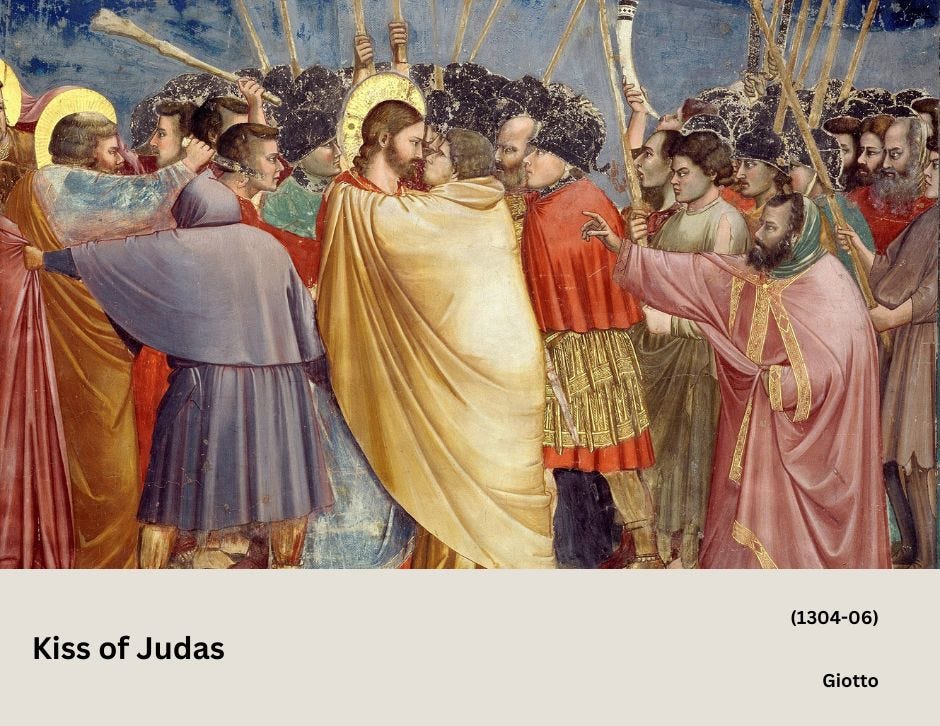
The last post turned to AI as “new fire.” This one turns to an older fire: betrayal.
Judas Iscariot remains one of history’s most enduring images of the ultimate sinner. Even today, a “Judas kiss” describes closeness ruined by greed, malice, or fear.
No one really knows why Judas betrayed Jesus. According to John’s Gospel, he managed the disciples’ money and sometimes helped himself, so greed may have been a factor. Pride might have played a role, too—resentment, rivalry, some imagined slight, or the feeling that his place in the group was smaller than he deserved.
Or maybe he had grown tired of waiting for Jesus to take the world by storm and hoped betrayal would force his hand. Most likely several motives combined. Whatever the reason, things went wrong quickly.
Judas left the table, led soldiers to the garden, and identified Jesus with a kiss. Afterward, he tried to return the money and took his own life.
An early church tradition suggests Judas died by suicide, not out of despair, but out of hope. Reasoning that God’s justice would lead to Hell, divine mercy would send Jesus there to rescue the damned. Judas sought to meet Christ in the depths for one final chance at redemption. It was a gamble on grace. [*]
That sounds over the top. Less so than the tidy piety that needs Judas to make salvation work.
The soul is revealed in attention. Love is attention beyond judgment, sometimes fooled by appearances. Jesus was not fooled; Judas deceived himself. If Judas were truly unlike the ordinary sinner, he could be kept at arm’s length. He is not. The kiss, the bargain, and what followed warn of something easily overlooked: sin is not always separate from closeness, loyalty, or faith. Sometimes it grows within them.
A clever devil doesn’t ask anyone to choose evil outright. He gives it a reason, a plan, and sometimes a conscience. The imagined good excuses the harm done on its behalf.
Being fooled is not only a failure of ignorance. The intelligent can be fooled by the very habits of mind that make them feel least vulnerable. Political leaders call betrayal “necessity” and convince themselves that preserving power is the same as protecting the republic. A friend repeats a confidence “for your own good” and discovers too late that concern can be self-interest with better manners.
The forms change. The betrayal remains. The modern “practical” betrayal often presents itself as strategic necessity: a loyal servant chooses the “greater good” over personal integrity, stages a public show of unity, and proceeds to dismantle what he was entrusted to protect. It is a Judas kiss dressed as duty.
Literature keeps returning to this tension. Two favorites come to mind: Herman Melville’s Billy Budd and Arthur Miller’s The Crucible. In Melville’s novella, Captain Vere sacrifices a Christ-like innocent to the “necessity” of martial law, proving that even a virtuous mind can dress up betrayal as duty. In Miller’s play, John Proctor is offered his life if he will sign a false confession. He refuses, knowing that survival purchased by betraying one’s name is no life at all.
Classically, Dante’s Inferno places Judas at the frozen core of Hell, suggesting that the ultimate sin is not heat or passion, but the cold, intellectual choice to treat a benefactor as a means to an end. Betrayal freezes the soul in total isolation.
A Midrashic saying turns the matter another way: “Happy are the righteous who turn the Attribute of Judgment into the Attribute of Mercy.” [**] That is the harder work. Judas can be condemned from a safe distance. The greater challenge is to see how judgment might become mercy without pretending betrayal is less than betrayal.
“If an enemy insulted me, I could handle it; if a foe attacked me, I could avoid it. But it is you, my companion and close friend, whose words are smooth as butter and soft as oil, yet are like drawn swords.” —Psalm 55
Sometimes evil is ourselves in disguise. We know how to be nice. Yet when the truth comes out, love may prove stronger, and judgment become mercy. Others can be blamed; only truth yields mercy.
Notes and reading
[*] For a deeper treatment of this kind of radical mercy, see David Bentley Hart’s That All Shall Be Saved. Hart draws on the ancient hope of the restoration of all things, in which God’s victory would not be complete until every soul is reconciled.
In that light, Judas’s death can be imagined not simply as an exit, but as a desperate attempt to encounter the Harrowing of Hell firsthand. Here, “hell” means Sheol or Hades, the domain of the dead, rather than the later image of final damnation. The tradition of Christ’s descent to the dead appears in the Apostles’ Creed.
Mercy is easy to praise until it reaches the person no one wants forgiven.
[**] Genesis Rabbah 73:3, on Vayetze. The Midrash contrasts the wicked, who turn the Attribute of Mercy into the Attribute of Judgment, with the righteous, who turn the Attribute of Judgment into the Attribute of Mercy. Translations vary; I have used a slightly smoothed rendering here.
“Salvific Dissolution: The Mystery of the Betrayal between the New Testament and the Gospel of Judas.” Published online by Cambridge University Press, December 14, 2016, pp. 111–124. The recently discovered Gospel of Judas has created much controversy among scholars. While Judas is clearly implicated in Jesus’ crucifixion in this text, scholars debate whether his actions should be understood positively or negatively.
What needs to be forgiven? Not only Judas’s sin, but the certainty that places his sin beyond mercy. In Job, God rebukes the pious friends who defend divine justice too neatly while honoring Job’s anguished honesty, even as Job is humbled. Judas presents a harder case: not an innocent man, but a test of whether mercy can reach further than moral certainty allows. The point is not to excuse betrayal. It is to question the confidence that knows in advance where God’s mercy ends.
Giotto di Bondone—The Kiss of Judas / The Arrest of Christ. Giotto helped move Western painting from stylized reverence toward embodied human reality. In this fresco, part of the cycle often considered his masterpiece, inner drama is carried by outward gesture: Judas reaches for Jesus, gathers him in the yellow cloak, and meets him face to face. Judas’s expression need not disclose everything; the kiss does enough. Betrayal takes the shape of love.
To visit the Scrovegni Chapel, people first wait in a climate-controlled room before going inside. Each visit lasts about fifteen minutes, and the automatic doors open only once for entry and exit to keep the air inside stable.