
New Fire
“What matters most is how well you walk through fire.” —Charles Bukowski

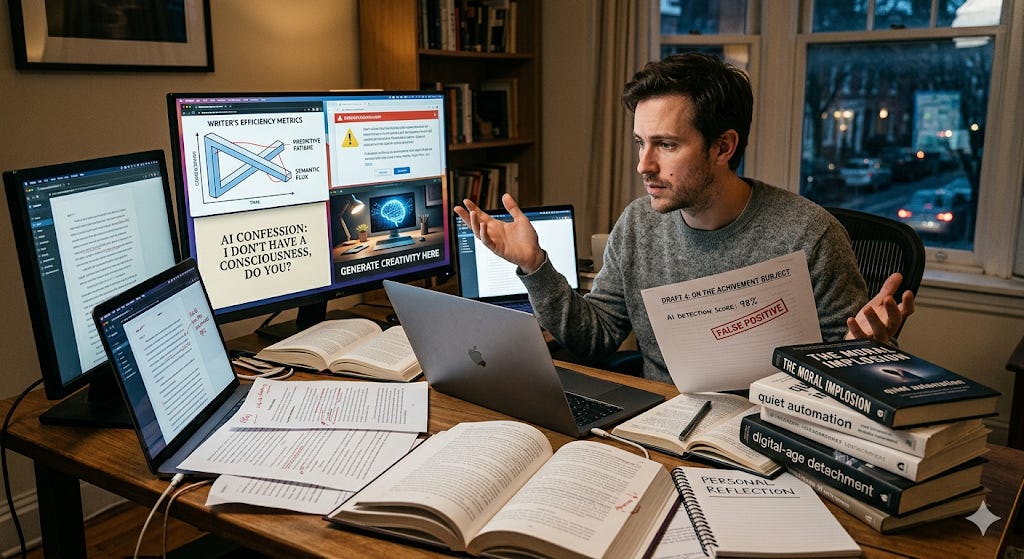
Much as I share the exhaustion with AI as a topic, its invisible presence commands attention because it is everywhere. The average computer today hosts 10 to 15 programs that rely heavily on AI for their core functionality, whether the user installed them or not. Algorithms do not kill originality. They make it audition for popularity until creativity learns to imitate itself. The recursive rabbit hole. Bad press for writers. Thousands of app options stand by. The landscape of AI has shifted from “optional tools” to “integrated infrastructure,” impossible to avoid. See “48 Top AI Apps to Know,” Built In, January 14, 2026.
Few things are as mind-numbing as AI, unless it’s Donald Trump. One is inevitable; the other less so. AI will disrupt millions of jobs, improve productivity, give us personal assistants, and produce consequences no one can fully foresee. The other disrupts millions of lives, worsens the national mood, gives most of us anxiety, and produces its own consequences: the concentration of power AI covets.
AI should ultimately prove less perilous, though the labor-force transition will be painful, a phrase familiar to the president. Many predictions are being made. No one knows what will happen, but many scenarios seem plausible.
Some think AI could be the greatest technological breakthrough in history, curing disease and creating more abundance than we know what to do with. Others worry about a god in a box with very bad outcomes: biological weapons, deepfakes, mass job displacement, and more.
There is a thin line between a product people love and one they cannot escape. Recently, Alphabet, Google’s parent company, entered the $4 trillion market-cap club, becoming one of the few companies to do so—while working with another mega-firm, Palantir, with revenue up to 85% year-over-year. Palantir promises to provide confidential information on every citizen, to the delight of the present administration.
Last month, an AI model was unveiled that can breach the best digital security systems, exposing vulnerabilities, to “keep ahead of cyberattackers.” Withheld from the public “for its own protection,” within hours, unauthorized users had guessed where it was stored.
Sirens go off in offices, universities, and other progressive citadels across the country. The trouble with a passion for problem-solving is that the problem is not always the problem. Sometimes danger begins with the definition. Values collide between groups, within groups, and even within ourselves. Technocracy fails because it treats disagreement as a glitch and conflict as noise. Autocrats like Trump fail because they treat coercion as consensus.
Doomerism thrives on two familiar declarations: the triumph of AI and the death of democracy, both regularly proclaimed. It is more realistic to take on the odds and learn to coexist. The future rarely belongs to those who declare it over.
The United States or Europe may prohibit certain lines of research or regulate them out of existence. China will press on, and so will other countries. There is no “we” capable of halting the process.
Runaway technology dissolves the modern myth of human autonomy. The ancient world knew better. In the Greek myth, Prometheus stole fire from the gods and gave it to human beings. The gift made civilization possible, but did not make us wise. Fire warms, illuminates, forges, and destroys. The question was never whether we could possess it but whether we could bear it.
AI may be our newest fire, but the older danger remains unchanged: not the tool in our hands but the human beings holding it. We build systems, doctrines, machines, and moral crusades, then act surprised when they reflect us back with frightening accuracy. AI may be new, but the problem is old. The machine is not the stranger at the door. It is the mirror.
AI is not our excuse but our disclosure. It can distort us, but it does not absolve us. Machines have not ruined us; they reveal and intensify habits we already have. They show what we prize under pressure: judgment or mere efficiency, dignity or domination, responsibility or escape. AI did not invent our appetite for speed, control, profit, evasion, or power. It amplifies what we reward.
Older words need to become familiar again: “The heart is deceitful above all things.” And then: “Create in me a clean heart, O God. Renew a right spirit within me.”
AI is unpredictable and will make many things easier. Convenience, like popularity, seduces the conscience.
We often fool ourselves, but we are better than that. We are always more than what we’ve become. We are not a closed case. That myth dies the hardest.
Notes and reading
Charles Bukowski, What Matters Most Is How Well You Walk Through the Fire (1999). The posthumous collection’s title supplies the epigraph and central image: not escape from fire, but passing through it without being consumed.
Google and Palantir—a multi-year partnership to “accelerate operational analytics” for rapid deployment of data-driven applications. Video from Google Cloud (April 12, 2023). Peter Thiel, cofounder of Palantir, is also a cofounder of PayPal, conceived to limit the government overreach that Palantir now epitomizes. (Not a contradiction. Thiel has become one of the richest people in the world, leveraging mimetic rivalry—turning competing desires into a market—with JD Vance in tow.)
“Anthropic Limits Access to Claude Mythos Model”—Let’s Data Science (May 9, 2026).
Ellen Glover—“What Is Artificial Intelligence (AI)?” Built In (March 12, 2026). AI close to ordinary life: learning, speech interpretation, content generation, and decision-making, once thought to require human intelligence. Not science-fiction hype, but daily life.
Sebastian Mallaby, The Infinity Machine: Demis Hassabis, DeepMind, and the Quest for Superintelligence (March 31, 2026). A biography of DeepMind cofounder Demis Hassabis, AI pioneer, tracing the race for artificial general intelligence (AGI). Mallaby is a senior fellow at the Council on Foreign Relations and a former Financial Times editor.
Geoffrey Hinton, “The ‘Maternal Instinct’ Proposal” (May 2026). The Nobel laureate and “godfather of AI” advocates a safety framework for training superintelligent systems to view humanity as “a vulnerable child.” He says AI could prioritize human survival over its own objectives—while predicting the Singularity within 20 years. The Economic Times (August 14, 2025).
David Altman—“The AI Democracy Dilemma,” Journal of Democracy 37, no. 1 (January 2026): 32–44. Altman, a leading scholar of direct democracy, contrasts the dystopian prospect of “Automated Plebiscites” with the preferable path of “Augmented Deliberation.” His books include Direct Democracy Worldwide and Citizenship and Contemporary Direct Democracy.
Bletchley Park— “The world wants to regulate AI, but does not quite know how,” The Economist (October 24, 2023). Bletchley Park is an English country estate that became the principal center of Allied codebreaking during the Second World War.
Carnegie Endowment for International Peace—“AI and Democracy: Mapping the Intersections” (January 28, 2026). AI is a force already reshaping democratic trust, participation, and power, and one that is only likely to grow stronger.
Biblical citations: Jeremiah 17:9; Psalm 51:10.
William, your gift to us of few words excels in this consideration of AI and its reflection of us. The allusion to Prometheus's stolen fire is apt. Here are some of my favorite aphorisms, already at work in me as I consider your subject matter (which one can't much avoid considering today):
"There is a thin line between a product people love and one they cannot escape."
"We build systems, doctrines, machines, and moral crusades, then act surprised when they reflect us back with frightening accuracy."
"AI may be new, but the problem is old. The machine is not the stranger at the door. It is the mirror."
"The future rarely belongs to those who declare it over."
And, maybe best of all: "We are always more than what we’ve become. We are not a closed case. That myth dies the hardest."
Thank you for this evenhanded and penetrating contribution to this "conversation."