
Against the Arrangement
Hipparchia: she left the loom and proved that “knowing one’s place” is often the first thing worth unlearning.

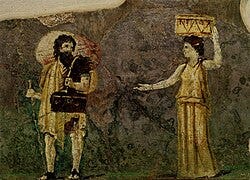
I began by looking for women in the Bible beyond the usual names. That search led elsewhere: to the broader neglect of women thinkers in the history of human thought.
Lately I have been writing about belief and belonging, and how both bear on courage and chaos in our own time. But those questions cannot be separated from another: Who has been allowed to think in public, and who has been told that thought itself was not their proper work?
That drew me to Hipparchia of Maroneia, whom I discovered almost by accident. Not because she left a great system. Not because we possess her writings. For nearly the opposite reason: so little remains, and yet the shape of her life still comes through with startling force.
Hipparchia left weaving and made the life prescribed for her look like poor thinking.
Some forgotten thinkers matter because of what they wrote. Hipparchia matters because of what she refused.
The exclusion of women was not only social. It was philosophical. Canonical figures helped give intellectual form to women’s subordination. Aristotle treated women as inferior in reason and authority. Later thinkers, including Rousseau, Kant, Hegel, Schopenhauer, and Nietzsche, repeated versions of the same assumption, lending inherited prejudice the appearance of theory.
Prejudice does its best work when it has become respectable.
Such arguments did not merely describe a patriarchal world. They helped defend it. Women’s bodies and minds were treated as unsuited for objective, abstract, or public thought. The result was a closed circle: women were denied education and authority, then their absence from learned life was cited as proof that they did not belong there.
Despite that exclusion, women taught, argued, wrote, advised, and appeared in the margins of traditions that often tried to erase them, though the evidence is frequently fragmentary or contested. The record is not thin because women were absent, but because cultures decide whose minds are worth recording.
Hipparchia interests me because she is not merely one more neglected name. She exposes the arrangement itself.
A woman of her class was expected to marry respectably, guard her reputation, manage the household, and remain largely outside public argument. Hipparchia did not simply ask whether the arrangement was fair. She walked out of it, centuries before the world knew how to call that freedom.
She broke the circle not by writing a treatise, at least none that survives, but by appearing where she was not supposed to appear, thinking where she was not supposed to think, and living as though philosophy belonged to her too.
Her argument had legs, sandals, nerve, and bad manners.
Born in the fourth century BCE in Maroneia, Hipparchia rejected the future laid out for her and chose the austere, public, scandalous life of Cynic philosophy. In a culture where education and public argument were treated largely as men’s work, her decision was not merely unconventional. Her presence itself became an argument.
She married Crates of Thebes, a penniless Cynic philosopher. Crates reportedly warned her that marriage to him meant sharing his poverty, rough clothing, public exposure, and contempt for status. Hipparchia chose that life anyway.
She did not simply marry a philosopher. She became one.
Cynicism did not originally mean sneering disbelief or weary distrust. It was an early enemy of sanctimony: a philosophy that tested virtue against the temptations of wealth, comfort, reputation, and approval. Cynics believed that freedom required self-command and a life stripped of social pretense.
Many philosophers praised courage and contempt for convention. Hipparchia had to live those virtues under conditions that made her very presence in public philosophy an offense.
Ancient accounts remember her not merely as Crates’ wife, but as a philosopher and public disputant. Later tradition also attributes writings to her, though none survive.
The best-known story places her in an argument with Theodorus the Atheist. Hipparchia reasoned that if an act was not wrong when Theodorus did it to himself, the same act could not become wrong merely because she did it to him. Theodorus had no answer. Instead, he tried to pull away her cloak, apparently hoping to shame her.
Hipparchia did not flinch. Public nudity was no threat to her.
When he mocked her for abandoning the loom, she replied: “Do you suppose that I have been ill-advised about myself if, instead of wasting further time upon the loom, I spent it in education?”
She refused the choice society had made for her: domestic obedience or public disgrace. She would be neither silenced nor ashamed.
Her relevance today is not only for women. She also speaks to men. In an age of branding, careerism, ideological display, and anxious self-presentation, Hipparchia asks whether our freedom is real, or merely obedience to a different audience.
Good thinking is the discipline of becoming less governed by fear, vanity, appetite, and applause.
Sometimes its first act is simply to appear where you have been told you do not belong.
Notes and reading
Hipparchia’s “left the loom” comes from an anecdote preserved by Diogenes Laërtius. The phrase is my own, but it follows the point of her reply: Hipparchia’s scandal was not merely that she thought, but that she refused the place assigned to her.—Lives and Opinions of Eminent Philosophers, early third century CE, 6.96–98. (Kindle edition, 2026).
Diogenes Laërtius was part biographer, part compiler of philosophical teachings, and part collector of memorable sayings, disputes, and human oddities. He was not a critical historian in the modern sense, and some of his stories are difficult to verify. Yet his work preserves traditions and fragments that might otherwise have disappeared. Without his appetite for both philosophy and personality, we would know far less about many ancient thinkers, including Hipparchia.
R. Bracht Branham, Marie-Odile Goulet-Cazé (editors)—The Cynics: The Cynic Movement in Antiquity and Its Legacy (edition consulted, 2023).
Virginia Grigoriadou—“Female Greek Philosophers of Classical Antiquity”—Istraživanja: Journal of Historical Researches 35 (2024), 7–33.
Sara Brill & Catherine McKeen (editors)—The Routledge Handbook of Women and Ancient Greek Philosophy (2024).
A corrective post. Needed. Thank you.
I had not heard of Hipparchia of Maroneia, of course. By taking away from her all of her writings, if any, and most of her words, the patriarchy she stood against highlights for me Eric Voegelin's distinction between philosophy and philosophers. When a polity says it wants philosophy, Voegelin suggests, what it unknowingly wants are philosophers. Voegelin’s philosophers stand out more by their soul than by their thought: philosophers are those “whose soul responds to eternal being.” Of course, Hipparchia stands out for both her thought and her response to something higher than the conventions that would turn her from herself. In fact, as you suggest, the two go together: “Good thinking is the discipline of becoming less governed by fear, vanity, appetite, and applause.” A wonderful essay. Thank you.