
The Stubborn Other
“One deed, and sometimes one word, suffices to change every constellation.” — Hannah Arendt, The Human Condition

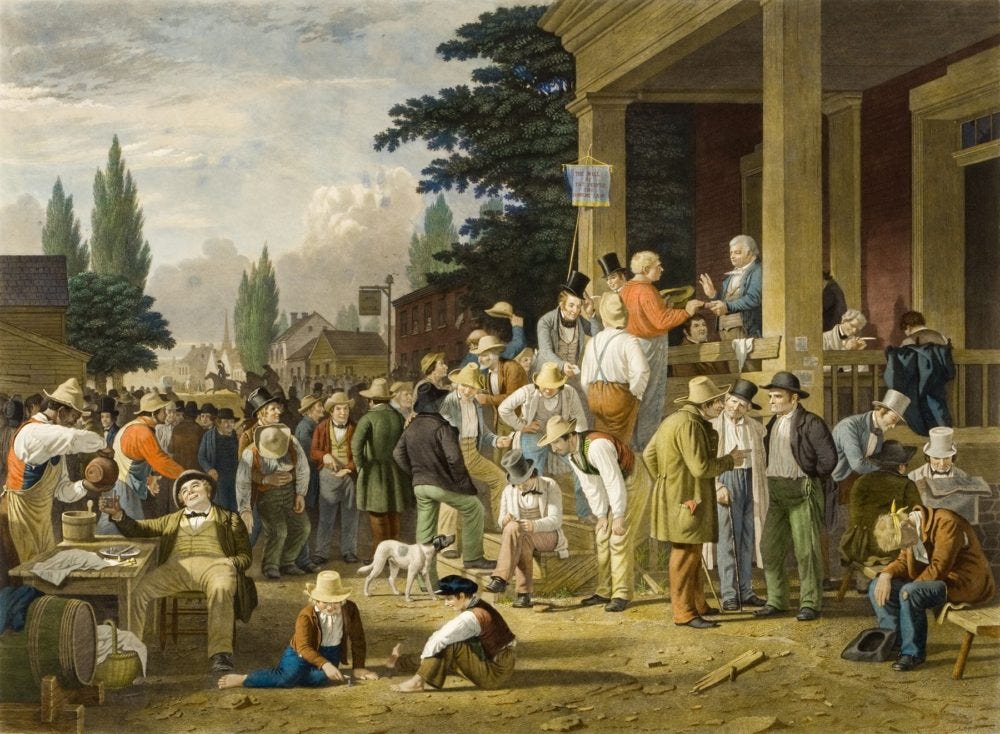
I’m tired of politics. It feels like one damned thing after another: spectacle chasing spectacle, the law falling further behind, the next election arriving like another threat. The answer just keeps blowing in the wind.
But that grief only goes so far, because I am also tired of myself. Easy to blame the culprits, harder to admit we are among them. We do not enter politics after becoming ourselves. Politics is part of how we become ourselves.
Each of us is a committee of selves: parent, partner, friend, worker, believer, doubter. We are pulled between duty and desire, work and leisure, autonomy and dependence. Diversity is easier when it’s not our own.
Politics does not begin with parties or governments. It begins in this daily tension of keeping the peace among our different sides, then reappears in families, communities, and states.
Aristotle’s “political animal” was no reduction to statecraft. It belongs to who we are, not merely what we do—our nature, not just our behavior.
We are born from others, sustained by others, formed with others, selves in a world we did not make alone. Politics is what happens when we reckon with this shared life. It is the hard human work of building a world out of differences, heavy memories, open conflict, and stubborn hope.
Hannah Arendt called this natality. Every birth brings a newcomer, but natality becomes political only when the newcomer acts and begins. Politics exists because we are alike enough to share a world, and different enough for something new to happen. It is how we make room for the future.
Arendt heard this truth in the Gospel announcement, “A child has been born unto us,” treating it not as dogma, but as radical faith in the world’s capacity to begin again. For her, we are not born to die, but to start anew—a human defiance of the odds that she called an “infinite improbability which occurs regularly.”
Yet no beginning is innocent. Genesis places the first city east of Eden, founded by Cain, the first murderer. Politics begins with the need to live together after innocence is lost. Every political order inherits the damage.
Scripture gives beginning another form in Abraham. God’s command to leave his country and his father’s house is a summons to begin without knowing where it leads, prizing promise over possession.
It is hard to trust that much. The easier alternative is retreat: into the self, the tribe, or walls that shrink the world until fewer count.
Political thinkers call the work of democracy “agonism”: turning enemies into opponents and conflict into debate. Agonism does not end disagreement. It transforms antagonism and keeps a fight from becoming a war, dissent from being a crime.
Nietzsche understood how moral struggle hardens into resentment, taking its purpose from the power it condemns, turning revenge into virtue. Resentment does not defeat the enemy. It lets the enemy decide who we become.
Soccer and baseball outclass football because players must play both ways: offense and defense. They let the game dictate the clock, not the clock the game—a match cannot be run out by holding the ball to kill time.
Football breeds the one-way specialist—and with that specialization, resentment. Democracy demands citizens who can both score and field, speak and listen. It requires a playing field, not a battlefield—contest, not conquest.
The end of polarization is not always a victory—sometimes it is just an eviction. Whether the hand closing the door belongs to a strongman or a righteous reformer, the result is the same: both are turning the key.
Enemies must be defeated, but opponents preserved—because power does not merely tempt; it transforms. Those who grasp it in God’s name must first secure it, making the god they invoked unrecognizable, a deity who always happens to agree.
Saul began as the Lord’s anointed; he ended consulting a witch. Left unchecked, power turns the highest ideals into a bargain with the devil, stepping over bodies to keep moving.
This delusion of absolute control extends to our private lives. We flatter ourselves that independence is the truth and dependence the illusion. But the self-made person is a myth. No one builds their own roads, purifies their water, or buries themselves. Worshipping self-sufficiency breeds the loneliness it promises to cure.
Reflecting pools turn stagnant, and the monuments we build to our own independence eventually crumble.
The test of a political community is how it treats those not yet members: the stranger, the refugee, the child too young to speak. A community drawing its circle too tightly hides behind safety and calls it justice.
Membership is the first political good, and inclusion means power, not mere permission to participate. At its best, politics gives common life form: our second birth into speech, action, and responsibility.
Yet that second birth can be refused. We can run from our differences as though to return to the womb, where we never shared space. But political life begins only after that illusion breaks.
We don’t just fear the stranger; we fear the neighbor—close enough to matter, different enough to disturb. Good neighbors build boundaries together. A boundary becomes a wall when only one side sets it, just as tolerance becomes a trap when only one side practices it.
D. H. Lawrence saw the danger in Walt Whitman’s totalizing embrace of humanity: it swallows difference rather than meeting it. “The universe, in short, adds up to ONE. ONE. 1. Which is Walt.” That is not communion. It is “an empty Allness. An addled egg.”
Real difference is harder. Other people do not exist to meet my needs; my need is to meet them. They are not here to complete our unity, but to interrupt it—and, sometimes, enlarge it.
That is the invitation: not to agree, not even to like one another, but to stay. To remain in the argument, in a shared, difficult world. To act without certainty, knowing a single deed or word can alter the order; we cannot speak into a void; a world begins when another answers.
Notes and reading
Wendell Berry on Interdependence—“A Native Hill,” in The Long-Legged House (1969), 196. Berry’s reversal of priorities serves as the ethical backbone for moving past political exhaustion. To shift from asking what is good for us to what is good for the world requires abandoning the myth of self-sufficiency. It demands a rigorous, localized attention to the shared environment and the neighbors we did not choose but must live alongside.
Aristotle, Politics, I.2, 1253a1–18.
Hannah Arendt, The Human Condition, 2nd ed. (1998), Part V, “Action.”
The Second Birth: On the Political Beginnings of Human Existence—Tilo Schabert (2015). Writing in the philosophical tradition of Eric Voegelin, Schabert builds a political anthropology around the concept of human beginnings and cosmic order.
The Beginning of Politics: Power in the Biblical Book of Samuel—Moshe Halbertal and Stephen Holmes (2017). The authors analyze sovereign power through the stories of Saul, David, Uriah, Tamar, and Absalom.
D.H. Lawrence on Walt Whitman—Studies in Classic American Literature (1923), Chapter XII, “Whitman.” Lawrence critiques Whitman’s democratic expansionism as the ego consuming the other under the guise of loving them. For Lawrence, true communion demands radical separateness; it is possible only when both sides remain stubbornly themselves, maintaining “the powerful resistance and cohesiveness of our individuality.” (Reflections on the Death of a Porcupine).
“The Stubborn Other” brings to mind Walter Lippmann’s famous essay “The Indispensable Opposition,” which reorients our concept of free speech from an individual right to a public necessity. William expands Lippmann’s notion of potential opposition to its source, the Other.
Lippmann says we need to grant the opponent the right to speak not so we can, in turn, insist on our own right to speak but so we can grow from our opponents’ perspectives. William, in addition, says that real political membership “means power, not mere permission to participate.” Compared with Lippmann’s essay, William’s essay involves not just perspectives but the entire person and community: “Other people do not exist to meet my needs; my need is to meet them.” Our second birth (and I look forward to reading Tilo Schabert’s *The Second Birth*) into “speech, action, and responsibility” describes the political community that nurtures the speech and listening that Lippmann celebrates.
More of my favorite lines from William’s essay:
“Diversity is easier when it’s not our own.”
“We are born from others, sustained by others, formed with others, selves in a world we did not make alone. Politics is what happens when we reckon with this shared life.”
“Politics exists because we are alike enough to share a world, and different enough for something new to happen. It is how we make room for the future.”
“We don’t just fear the stranger; we fear the neighbor—close enough to matter, different enough to disturb. Good neighbors build boundaries together.”
“To remain in the argument, in a shared, difficult world. To act without certainty, knowing a single deed or word can alter the order; we cannot speak into a void; a world begins when another answers.”