
The Fire, This Time
“What is he doing there?” “He is putting out the fire, Your Excellency.” “Not likely. The fire is in the minds of men, and not on the roofs of houses.” —Fyodor Dostoyevsky, The Possessed

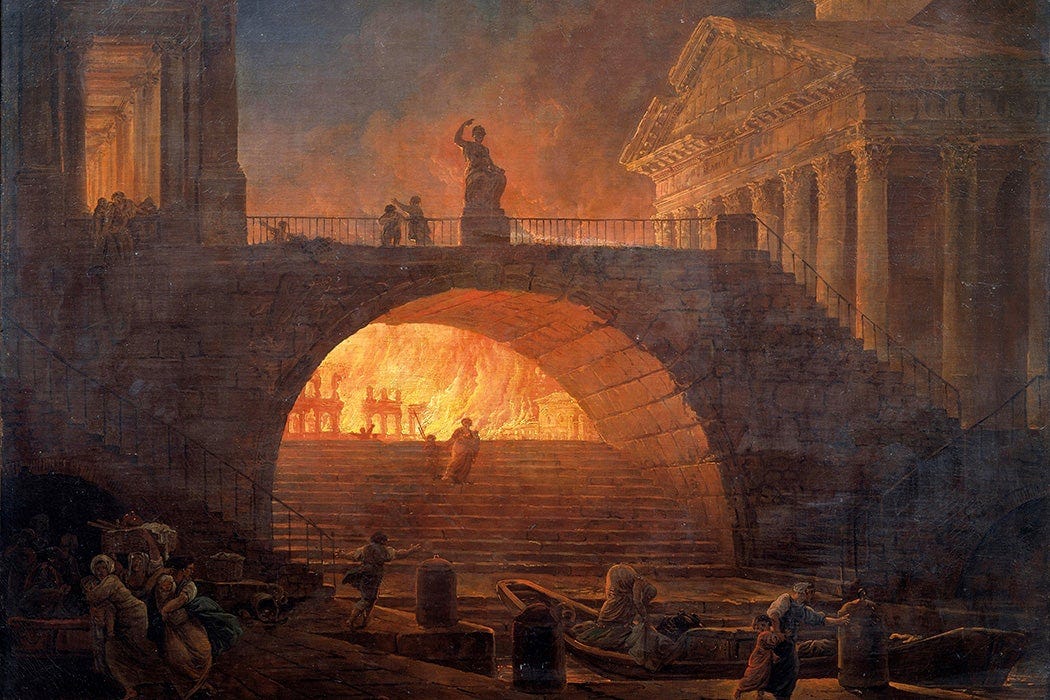
For most of history, fire was a mainstay of daily life, providing warmth, food, and protection. Industrial societies changed this, hiding combustion inside engines, furnaces, and power plants. Fire became less visible even as we depended on it more completely, trading the open flame for controlled progress.
This confidence shaped land management. For decades, governments aggressively suppressed fires across forests and grasslands. They interrupted natural cycles, allowing undergrowth to accumulate in ecosystems long adapted to burning. Fire did not disappear; the fuel gathered.
It is returning, intensified by heat and drought. Thousands of wildfires cross Canada, sending plumes of smoke into the jet stream. The damage extends far beyond the fire line. Fine particulate matter clogs lungs, worsens respiratory illness, and spikes heart risks.
When a forest burns in one country, people in another are warned to stay indoors. Climate change arrives no longer as a statistical projection, but as a visceral reality borne out in an apocalyptic sky and the sharp smell of smoke. Many treat air quality warnings as background noise until breathing makes it personal.
No single cause explains a wildfire. Lightning and human sparks matter, but so do drought, land use, and a century of total fire suppression. Climate change parches vegetation and extends fire seasons, increasing the odds that a single spark will morph into a regional disaster.
George Saunders, the American novelist and short-story writer, brings this crisis into devastating focus. His fiction combines grotesque comedy with tenderness, refusing the easy choice between judging people and recognizing their humanity. Art is always about more than itself.
His new novel Vigil places K. J. Boone, a fictional oil executive dying of cancer, under the care of Jill “Doll” Blaine, a spirit assigned to comfort him. Boone helped suppress climate science and defend an industry whose benefits he invokes to justify its damage. Victims, animals, former associates, and other spirits gather around his bed, demanding something closer to judgment.
The novel turns combustion into moral consequence. Heat, drought, smoke, and burning landscapes appear as the accumulated result of decisions made in offices, laboratories, legislatures, markets, and ordinary lives. Fire becomes the visible afterlife of choices once kept distant and abstract.
Saunders does not make accusation simple. The executive is culpable, but not a cardboard monster; he genuinely believed society demanded the comforts fossil fuels provided. Vigil asks whether compassion can face grim truths without surrendering judgment or mercy, even when repentance never comes.
However, a single villain risks letting the reader off the hook. A clear villain clarifies guilt but can conceal how widely the blame is shared. Some profited from deception; others merely benefited from the system or felt powerless.
Fyodor Dostoevsky, the Russian novelist, once wrote that the fire is not on the roofs of houses, but in the minds of men. Today, our predicament cannot be so easily divided. The fire is simultaneously in the forests, our lungs, our policies, and our habits. The task is to name responsibility without letting complexity become an alibi—or failure seem inevitable.
Fatalism claims the future is fixed. Pessimism expects decline but leaves room for action. The philosopher Mara van der Lugt describes “hopeful pessimism” as a refusal to believe progress is a given. It asks us to act without assurance of success, to lessen the worst because the worst is not yet set in stone.
Van der Lugt focuses on climate activists, and she considers the pessimist who approaches her activism with this attitude: “Our efforts are likely to fail—and we will do what we can nonetheless.” You act, not because you think you can keep the rising temperature of global warming to one and a half degrees, but because anything you do to mitigate the worst, which is not inevitable, has value.
Many are withdrawing from public life—abandoning fractured institutions, hyper-partisan cities, and conventional careers. Exhausted by an overheated culture and planet, they look for an escape hatch, a migration captured by the film Nomadland and the ethos of what the intellectual media platform Big Think calls “The Opt-Out Nation.”
But we cannot opt out of breathing.
When the smoke clears, and we breathe easily again, the very conditions that fed the fire are still accepted as normal. Hope begins by refusing both evasion and surrender. We can’t live together, or live at all, as nomads fleeing under a burning sky.
Václav Havel, the Czech dissident, playwright, and later president, called hope not a “prognostication,” but “an orientation of the spirit,” an internal force that allows you “to work for something because it is good, not just because it stands a chance to succeed.”
Hopeful pessimists can lessen the worst, and make room to breathe.
Notes and reading
[*] Nero and the Fire—Hubert Robert’s The Fire of Rome, July 18, 64 AD (1785) imagines the catastrophe through the grand architecture and theatrical light of eighteenth-century history painting. Nero did not fiddle while Rome burned—the fiddle did not yet exist—and he was probably outside Rome when the fire began. Ancient sources disagree about his conduct and possible responsibility, though the story proved too useful to disappear.
Art and morality—A brief link to my last post on Ursula K. Le Guin. Much in the spirit of George Saunders, she wrote: “I do not feel a real difference in kind—or even of importance—between the ethical and the aesthetic inquiry. But to pursue that statement further would require some understanding of philosophy, and I have none.”
Stephen J. Pyne, The Pyrocene: How We Created an Age of Fire, and What Happens Next (2021). Pyne places today’s fires within humanity’s long, uneasy history of burning. By consuming fossil fuels on a planetary scale, he argues, we have not merely warmed the climate but remade Earth into a fire age of our own making.
Luke T. Kelly and others, “Fire and Biodiversity in the Anthropocene,” Science (2020). Why fire is not simply destructive and why healthy landscapes require better fire management rather than universal suppression.
Mara van der Lugt, Hopeful Pessimism (2025). Van der Lugt rejects the demand for optimism in a world coming apart. Pessimism, she argues, need not mean despair or surrender. Refusing to assume that progress is inevitable can make hope more honest and moral action less dependent on the promise of success.
Climate Fiction, timely now—Notable examples include David Mitchell’s Cloud Atlas, linking environmental destruction to exploitation across generations; Octavia E. Butler’s Parable of the Sower, set amid fire, displacement, and social collapse; Claire Vaye Watkins’s Gold Fame Citrus, about a drought-ravaged California; Kim Stanley Robinson’s New York 2140, imagining a flooded but still unequal city; and Richard Powers’s The Overstory, exploring the bond between human and arboreal life. Together, they address ecological breakdown, inequality, survival, adaptation, and renewal.
Thanks for this. From a hopeful pessimist with fire in heart.