
Backing Forward
We back into what comes next.

Not long ago, I reached for my phone during a few unoccupied minutes. I expected no news, message, or amusement. Silence had appeared, and almost before noticing it, I moved to fill it.
How much of life is spent avoiding the pause that makes our assumptions visible? We inherit loyalties, fears, ambitions, and ways of seeing. Then distraction saves us the trouble of asking whether they are true. Besides, distraction now has a gig economy behind it—digital fakery just a click away—something else to get upset about.
Unexpected help came from Ursula K. Le Guin, whom Harold Bloom credited, more than Tolkien, with raising fantasy into high literature. Her speculative fiction did not so much predict the future as estrange the present. She invented unfamiliar worlds to expose assumptions too familiar to see.
Nietzsche approached the problem differently. He called the passive, comfort-seeking person who abandoned meaning “the last man.” The danger was surrender without drama: the loss of curiosity, judgment, risk, and inward independence.
When inherited meanings weaken, freedom does not necessarily follow. Responsibility shifts to leaders, movements, institutions, nations, or the crowd. Distraction replaces attention. Summaries replace books. Artificial intelligence can produce the evidence of thought while allowing thought itself to go missing. Productivity displaces reflection.
Freedom shrinks to choosing among ready-made options rather than questioning the values behind them.
The culture wars persist because certitude keeps them going. The quarrel is not over belief or unbelief—God, reason, science, religion, right and wrong. It begins when we mistake our understanding for reality, our convictions for truth itself, and the limits of our vision for the limits of what is true.
Soon civility is cowardice, compromise is treason, and everyone is a knight of righteousness riding out to destroy somebody else’s heresy.
Ralph Waldo Emerson saw hope in what certitude resists. In “Circles” (1841), he wrote: “People wish to be settled; only as far as they are unsettled is there any hope for them.”
Emerson was not praising confusion. A settled mind can become closed. New thought begins when conviction admits surprise, correction, and unseen possibilities. Unsettlement reminds us that neither world nor self is finished.
An old Greek image placed the past before us and the future approaching from behind. We backed into what came next with memory, not foresight.
Memory is not nostalgia. Nostalgia reshapes the past to meet present needs; memory recovers possibilities the present has forgotten. Yet history gives no map, only warnings, and memory can become blindness when we recognize only familiar dangers.
Meeting what comes next requires imagination: seeing forms of life and truth our inherited categories conceal.
Le Guin’s The Left Hand of Darkness makes that work of imagination more than science fiction. Published in 1969 and winner of the Hugo and Nebula awards, the novel sends a human envoy into an unfamiliar world—and makes his assumptions the strangest things there.
The novel follows Genly Ai, a human from Terra sent to Gethen as an envoy of the Ekumen, a confederation of worlds. Believing himself open-minded, he invites Gethen into a larger human community. Yet he carries assumptions he cannot see.
The people of Gethen are neither permanently male nor female. Their societies developed without the fixed gender divisions Genly considers natural. He repeatedly misreads his ally Estraven because Estraven does not fit his ideas of strength, loyalty, honesty, or trust.
Genly thinks he is judging Estraven. Instead, Estraven is exposing the limits of his imagination.
Politics makes that blindness more dangerous. Karhide, the kingdom where he first arrives, is shaped by nationalism, fear of outsiders, and suspicion at court. Neighboring Orgoreyn is bureaucratic and totalitarian, presenting itself as rational and efficient while concealing surveillance, coercion, and repression. The two states differ, yet both narrow loyalty until concern for humanity appears as betrayal.
Estraven sees farther. Condemned as a traitor, Estraven understands that loyalty to one’s country may require refusing to be governed by its fears. Nations matter, but no nation is the whole of humanity. Order that loses sight of truth becomes another kind of blindness.
During their long journey, Genly begins to understand. Stripped of political theater and familiar categories, they must depend upon one another. Trust grows not out of sameness, but out of attention.
Le Guin moves beyond both Nietzsche and Emerson. Freedom is not merely the strength to create values, nor does openness require abandoning conviction. It requires the humility to discover that some of our deepest assumptions may be provincial.
Genly changes because, at last, he can meet another person without forcing that person into familiar categories.
The future still approaches from behind. We will not meet it by repeating inherited answers or congratulating ourselves on independence. We will need memory without nostalgia, conviction without certitude, and loyalties large enough to survive correction.
Perhaps that is why those empty minutes matter. The reflex to fill silence may be more than impatience. It may be reluctance to face what has not yet been decided—including ourselves.
The danger is not only that power may command us to stop thinking. It is that we may mistake the limits of our vision for the limits of reality. The impulse to escape uncertainty becomes, paradoxically, an escape from life itself.
Le Guin gives uncertainty the final word:
“The only thing that makes life possible is permanent, intolerable uncertainty: not knowing what comes next.”
Notes and reading
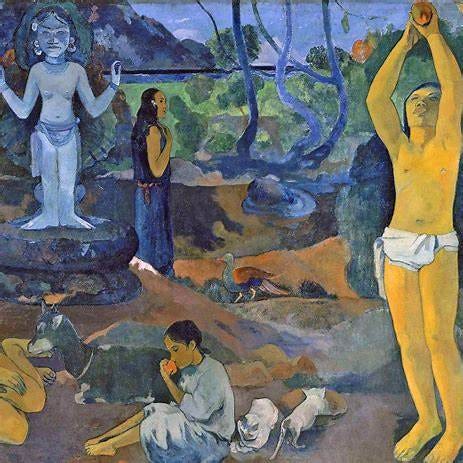
Paul Gauguin, Where Do We Come From? What Are We? Where Are We Going? (1897–98). Gauguin conceived the painting as a meditation on human existence. Its figures move through stages of life without resolving the questions named in its title.
Ursula K. Le Guin (1929–2018) was a major American writer of speculative fiction and a longtime student of philosophical Taoism. Its themes of balance, interdependence, restraint, and action without domination shaped much of her work, along with a suspicion of mastery and attentiveness to apparent opposites.
Ralph Waldo Emerson, “Circles” (1841). Emerson’s remark that “People wish to be settled; only as far as they are unsettled is there any hope for them” belongs to a larger vision of thought and life as continual expansion. Readers committed to linear, progressive, or Christian apocalyptic accounts of time may resist its recurrent imagery. The quotation is used here not to deny enduring truth, but to defend openness to correction, surprise, and truths not yet fully seen.
Taylor Dotson, The Divide: How Fanatical Certitude Is Destroying Democracy (2021). Political polarization grows not only from indifference to truth, but from the conviction that one’s own facts or values should make disagreement unnecessary.
Fact, fiction, and imagination—For Le Guin, fiction is invention but not falsehood. Wishful thinking escapes reality; imagination begins with reality and returns to enlarge it. Through imagination, we may come closer to knowing the minds and hearts of others. See Ursula K. Le Guin, “Making Up Stories,” Words Are My Matter (2016).
I wasn’t aware of the Ancient Greek orientation of time in which we “face” the past, not the future. It’s quite helpful.
Perhaps it’s somehow related to Deuteronomy’s orientation: if we keep the law (given in the past) as frontlets between our eyes (before us), then blessings will “overtake” us (in the future, of course, and as if from behind us).
The notion of us standing between past and future also reminds me of Arendt’s preface to Between Past and Future. Your observation that “When inherited meanings weaken, freedom does not necessarily follow,” seems to be her concern there. The “thread of tradition” has broken, she says, causing “the gap between past and future” to become “a fact of political relevance.” This unsettled gap, she says, “is the only region perhaps where truth will eventually appear.” And thinking today, she says, cannot be done anywhere but in this gap. Maybe she and Emerson, whom you quote here, were following the same intuition: “People wish to be settled; only as far as they are unsettled is there any hope for them.”
Her preface, of course, leads her to describe her book’s essays as exercises in such thinking, not as “prescriptions on what to think or which truths to hold.” Your essay, as usual, is such an exercise for me. Thank you.