
Shrewdly Honest
“The master commended the dishonest manager because he had acted shrewdly.” Luke 16:8

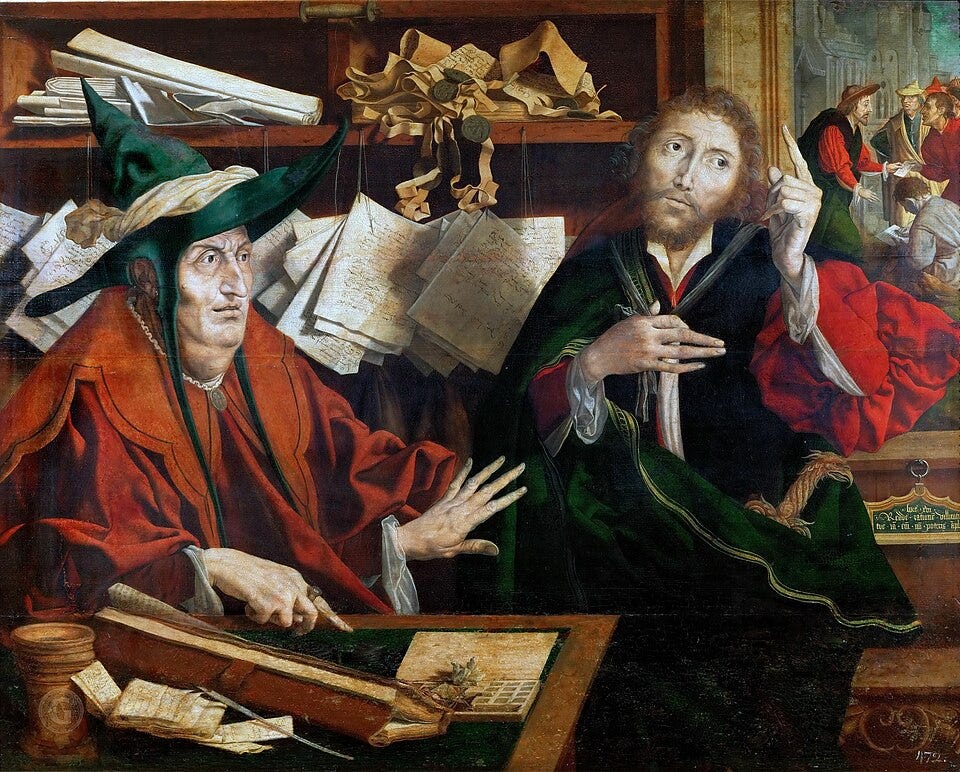
A friend once told me he had stopped asking whether an institution was honest. He asked what good could be done through it.
The people who helped most were the ones who knew which door was closing, which rule could bend, which budget line could be moved, and when waiting would be harmful.
The end does not justify the means, except when we start hoping it does. That hope has many names: peace through strength, law and order, national security, temporary emergency powers, necessary force. Soon getting something done matters more than asking what we are doing.
Much committee life and much of politics work this way. A seat at the table becomes the point of the meeting. Winning office becomes the purpose of politics.
Innocence becomes hard to place. Sometimes it feels like integrity. Other times it looks naive, even like a luxury someone else can afford. Graham Greene put the harsher verdict sharply in The Quiet American: innocence can mean no harm and still deserve “a leper’s bell.”
Shrewdness becomes hard to place too. Is it wisdom under pressure, moral concession, or what survival looks like in a crooked world?
Then comes Jesus’ puzzling parable of the Shrewd Manager, often called the Unjust Manager. A rich man discovers his manager has been wasting his property and fires him. Facing ruin, the manager calls in his master’s debtors and slashes their bills so that when he loses his job, they will owe him favors.
The scandal is sharper still. The master praises the dishonest manager for his shrewdness, and Jesus seems to hold him up as an example. The man is not generous or repentant. He is trying to survive. He cuts the debts not because his heart has changed, but because his circumstances have.
The books will not save him. His title will not save him. Respectability is poor protection when the accounts are opened. So he uses the little power he has left to make sure someone will open the door when he has nowhere else to go.
Jesus is not blessing fraud, which already has its excuses. He is exposing the lethargy of the well-meaning. “The children of this age,” he says, know how to act with urgency. The “children of light” often do not. They can be so determined to stay innocent that they become useless, harmless in their own minds while harm goes unanswered.
The Shrewd Manager is stripped of respectable illusions. He knows time is short. He knows the system is compromised. He knows accounts fail, positions vanish, and official security can disappear overnight. So he uses what he cannot keep to create what he will soon need.
That does not make him admirable. It makes him instructive.
Prudence may be the virtue, but shrewdness is often what it looks like under pressure.
The parable asks whether we are using our temporary resources — money, time, attention, access, influence — to preserve our standing inside failing systems, or to spend them on mercy, loyalty, friendship, and courage that might survive them.
Shrewdness is dangerous, but so is innocence that means no harm while leaving harm untouched.
Nor is this simply the lesser of two evils, as though the choices are already clear. Shrewdness begins when responsibility requires acting before circumstances fully disclose themselves.
A dangerous thing about innocence is its refusal to acknowledge dependence. Separatists on the Right and Left denounce capitalism and consumer culture while living off the supply chains, platforms, markets, and protections they criticize.
There is a kind of guilt that serves as a bid for relevance. Unable to change a broken world, people trade powerlessness for blame. Being an accomplice can feel less humiliating than being a bystander, because if you are guilty, at least you matter.
Philosopher Martha Nussbaum’s “monarchy of fear” gets at the deeper condition: fear makes us desperate to feel morally central, even when we are not politically powerful.
Luther’s “sin boldly” was a warning against false purity: act, repent, trust mercy, and do not confuse a clean self-image with faithfulness. The point is to become responsible enough to act, instead of mistaking disgust for action or innocence for integrity.
Goodness itself, armed with respectable methods and high ideals, can do terrible harm in the name of goodness. The paperwork may be impeccable.
It is precisely this obsession with respectable goodness that Jesus disrupts. The parable refuses a polite account of grace. Mercy enters through unlikely people and compromised systems, using even “unrighteous mammon” to open doors. If dishonest wealth can become an instrument of mercy, imagine what that means for the rest of us.
And here the parable goes deeper. The manager may be more than an example. He may point, however strangely, toward Christ, who forgives debts, welcomes the indebted, and offends those who think the books should balance.
Thank God we do not have to deal with a just steward.
Jesus’ parable leaves us with a harder question: why are the “children of this age” often more shrewd than the “children of light”? Elsewhere, Jesus tells his followers to be “wise as serpents and innocent as doves.” Not clever instead of good. Not pure instead of practical.
Both.
The hope is not to avoid trouble or be spared conflict, but to move through a compromised world with open eyes, open hands, and courage toughened by a broken heart.
Notes and reading
The parables. Jesus’ parables are not improved Aesop’s fables or sayings fit for church signs. They do not make morality neater. They make evasion harder. The Shrewd Manager presses directly on ordinary life: money, reputation, power, dependence, and mercy inside compromised systems.
The Parable of the Shrewd Manager. Luke 16:1–13. The scandal is that Jesus uses a morally compromised figure to expose the spiritual paralysis of the respectable.
Shrewd. In Luke 16, “shrewd” means practical wisdom under pressure, not mere cleverness or deceit. It is urgent realism once the accounts are opened: seeing what is at stake and acting before the door closes. Modern English makes the word sound colder and more calculating. Jesus is not praising dishonesty. He is praising clear-eyed action in a crisis.
Other biblical references. “Children of this age” and “children of light” come from Luke 16:8, where Jesus contrasts those who know how to act when crisis comes with those whose goodness has gone passive. “Unrighteous mammon” comes from Luke 16:9: money and profit are not inherently wrong, but they are never innocent. Matthew 10:16 joins the qualities the essay holds together: “wise as serpents and innocent as doves.” Without innocence, wisdom becomes manipulative. Without wisdom, innocence becomes naive.
Dependence. None of us stands outside the networks we criticize: supply chains, platforms, markets, laws, protections, institutions, and other people’s labor. Innocence becomes evasive when it denies what sustains it.
Martha Nussbaum, The Monarchy of Fear: A Philosopher Looks at Our Political Crisis (2018). One of the world’s most celebrated moral philosophers, Nussbaum argues that fear, especially when joined to powerlessness, feeds anger, disgust, blame, scapegoating, and the longing for simple answers and strong leaders, thereby weakening democratic trust.
Martin Luther, “sin boldly.” Luther’s phrase comes from a 1521 letter to Philip Melanchthon. It is often quoted with a straight face, then carefully defended because it sounds reckless. The point is to attack false purity: act in a broken world, repent honestly, trust mercy, and do not confuse a clean self-image with faithfulness.
Victor Hugo, Les Misérables. Jean Valjean begins as a criminal and a fugitive. His moral life is transformed not by respectability, but by a scandalous act of mercy. Bishop Myriel returns the silver Valjean stole, then saves him by calling the theft a gift. Across Les Misérables, law, property, guilt, debt, mercy, and survival collide. Grace enters through acts that look improper. Mercy sometimes breaks expected reckoning.
I appreciate how you exchange your initial thoughts about this curious parable into the currency of international relations and power politics. The parable seems to take us into the marketplace, but most of us don’t seem to know what kind of notes the parable finds us holding.
I’ve found that the parable of the shrewd manager is like the now-dated concept of “listening to Prozac”: prescribe the drug to help arrive at the diagnosis. I learn more about people’s spirituality by how they process this parable. (I sometimes hesitate to share my own reading of this parable because of what it might reveal about me.)
How do we account for ourselves in a world of credit lines, a world also charged with the grandeur of God? You effectively use the parable as a speculative instrument by developing a splendid dialogue between innocence and shrewdness.
Your remarks on the manager helps me see Paul’s advice to “those who use the world, as though they did not make full use of it” in a new light. Certainly, our parable’s manager operated on Paul’s advice in a sense, getting pennies on the dollar, and understanding himself as a mere agent (whether going beyond his authority or not).
And the manager’s “sit down quickly” seems to anticipate paperwork that won’t hold up among the just—or at least among the punctilious.
I found Robert Farrar Capon’s take on the parable enlightening, and you brought me back to it. Capon’s use of the parable’s narrative seems limited by his central thesis that Jesus is presenting himself as the shrewd manager. You bring out this aspect of the parable, too, and I agree with you and Capon. I just think Capon limits the parable in a way that you don’t, possibly because Capon seems burdened by an ever-present history of redemption.
You and Capon draw one same conclusion, though: “Thank God we do not have to deal with a just steward.” Amen. The master didn’t seem pleased with the servant who avoided the marketplace and balanced his books by returning what he had received. Innocence past its maturity date is dangerous.