
Freedom as Argument
The Unfinished Fourth

On the night the dictator fell, citizens of Caracas poured into the streets, singing the old city songs. For a few hours, the city reclaimed its history as la cuna del Libertador—the birthplace of Simón Bolívar, who helped lead much of South America to independence from Spain.
That was Venezuela on January 23, 1958, when my family lived there. Marcos Pérez Jiménez had fled. By Independence Day, fireworks rose from the barrios.
Tyranny had given way to democracy, and security to freedom, but also to disorder once fear no longer kept the peace. In place of the old right-wing order came elections, parties, rivalries, and the fragile work of self-government.
Bolívar’s old dilemma returned. Liberation was real, but unity had to be won again. Bolívar eventually dissolved the legislature to take dictatorial powers—a desperate attempt to force unity from the top down.
Nearly two centuries after Bolívar, a new breed of populist arose to master a different kind of chaos, breaking the economy while claiming to speak for the poor. The ruin of Hugo Chávez and Nicolás Maduro ended in January 2026, when U.S. forces removed Maduro, only to leave Venezuela in the hands of a loyalist of the same system.
The American founding generation feared this very thing. King George was no Pérez Jiménez, but to the colonists, he was close enough. Yet Jefferson, Madison, Adams, and their generation knew monarchy was not liberty’s only enemy. A republic could just as easily be ruined from within by the chaos of faction, demagoguery, corruption, cowardice, and the lust for power. They had overthrown a king; they had not abolished tyranny.
History is a nation’s memory: the stories it argues over, revises, and passes on. David Bentley Hart has playfully called baseball America’s most redemptive form of memory—a civic ritual where childhood, moral reckoning, and national story meet. The playfulness carries a serious point: nations need a shared remembrance that does more than flatter, one that makes room for individual excellence inside a common game.
Time reveals which victories contained defeat, which disasters carried possibility, and which small turns changed nations. People who forget this become easier to flatter, frighten, and rule. They also become quicker to reduce American history to a single master key, whether slavery alone, as in The 1619 Project, or patriotic innocence, as in The 1776 Report.
As the United States approaches its 250th anniversary, a republic bound more by shared ideals than ethnicity struggles to tell a common story. Older stories minimized slavery and conquest; later scholarship corrected those omissions but fractured the story into separate histories of race, class, and identity.
The harder task is to hold universal claims and particular histories together. We must affirm common ideals without erasing difference, and honor difference without retreating into rival camps. A common story that leaves people out becomes propaganda. Separate stories that lose sight of one another become tribalism.
1776 is an unfinished struggle over power, empire, slavery, and self-government. The Revolution became an argument over who counts as “the people.” It carried forward dispossession, racial nationalism, and damage that cannot be talked away. But the same Revolution that compromised with slavery gave later generations the language to condemn it: inalienable rights, higher law, and the right to resist power.
Democracy provokes reaction because it means living with big differences, uncertainty, and change. For those who want order without conflict, this can feel less like liberty than futility. Authoritarianism is a reflex democracy itself can trigger. When freedom feels like disorder, people start looking for someone strong enough to end the argument.
Civility cannot be reduced to manners. It is not deference, or the pretense that disagreement can be solved by being agreeable. Opponents do not have to like each other, but they must keep the conversation going.
We are stuck in the same boat with people we may distrust, dislike, or despise. Listening is not always an act of goodwill; it has long been a tool of the powerless—a way of “listening up” to anticipate the powerful.
Still, as Teresa Bejan argues, democracy depends on keeping argument alive so that disagreement does not harden into separation, persecution, or violence. The answer to hate speech is more speech. Sometimes democracy simply means saying, “Maybe we can talk about this later,” and leaving without slamming the door.
Conversely, tolerance becomes cowardice when it mistakes avoiding trouble for keeping peace. Politeness makes matters worse when it drains argument of substance and treats conflict itself as failure. Real civility is to politeness what moral courage is to etiquette.
A sound account of 1776 holds together violence and vision, exclusion and ideal, the republic built and the democracy still unfinished. Unfinished hopes do not nullify hard-won progress—they make argument necessary.
Argument hurts. John Adams and Thomas Jefferson felt that as much as anyone. Their bitter, personal rivalry proved that fierce opposition need not end in permanent estrangement.
Adams argued for a strong, independent executive: one person with enough energy to execute laws and check legislative power. Jefferson feared the tyranny that can wear the mask of consent, warning that “an elective despotism was not the government we fought for.”
Jefferson and Adams never stopped contending; even their eventual friendship did not settle the argument.
That, too, is part of the legacy of 1776: freedom as an argument fierce enough to divide a country, and durable enough to keep one.
Notes and reading
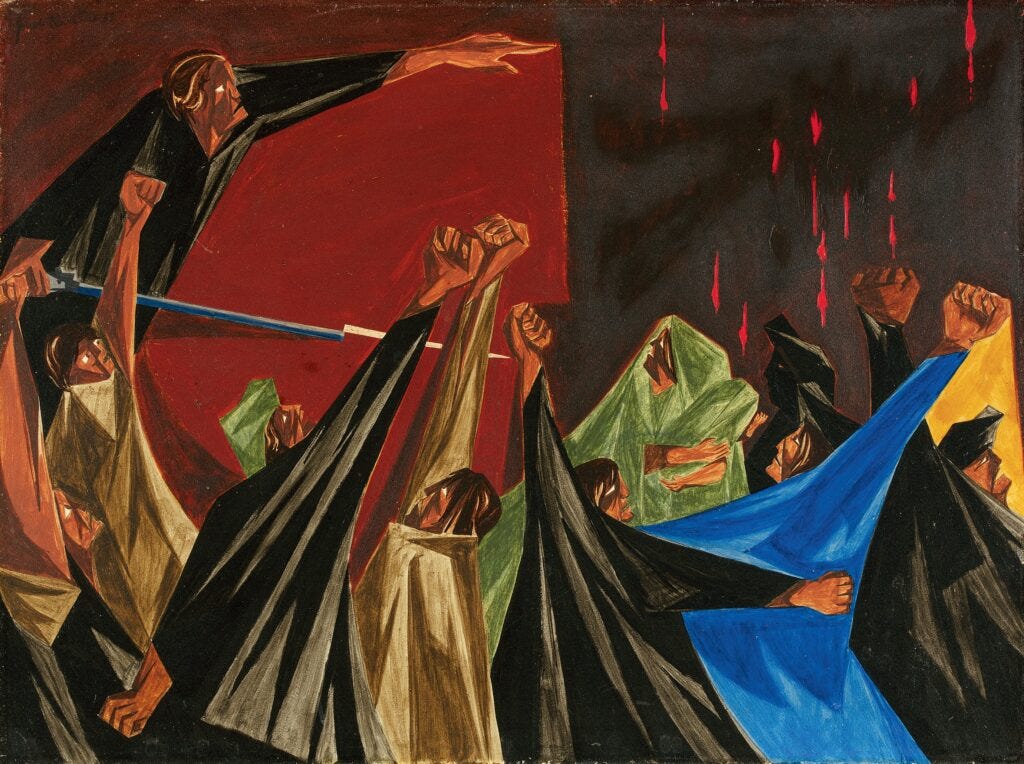
Jacob Lawrence—artist, Struggle, Panel 1; the first African American artist to have his work acquired by The Museum of Modern Art. “I do not look upon the story of the Blacks in America as a separate experience to the American culture but as a part of the American heritage and experience as a whole.” —MoMA
Venezuela—“Modern History of Venezuela 1900–2025,” Medium, January 8, 2026.
Baseball—Venezuela’s national pastime, too, and a small mercy in this essay. David Bentley Hart calls baseball “America’s most redemptive form of memory,” but Venezuela has its own deep claim on the game, from Caracas sandlots to Luis Aparicio, the Hall of Fame shortstop whose name still crowns the annual award for Venezuela’s best major-league player. See Hart, “Running in Circles: There is only one truly redemptive form of memory: baseball,” Plough, June 17, 2026. After all the revolutions, perhaps hope still knows how to come home.
[Note: On March 17, 2026, Venezuela became the first South American team to win the World Baseball Classic, defeating the host United States 3–2 in Miami, a moment of national joy amid continuing political and economic turmoil.]
Friends Divided: John Adams and Thomas Jefferson—Gordon S. Wood, 2017. Jefferson and Adams differed sharply: Jefferson, the aristocratic Southern slaveholder and democratic optimist; Adams, the striving New Englander wary of popular rule. Their friendship, rupture, and reconciliation expose the argument at the heart of the American founding.
The Unfinished Business of 1776: Why the Revolution Never Ended—Thomas Richards Jr., 2026. Politics emerged from the Revolution as an evolving contest between legal order and popular protest, not the easy consensus and settled authority later evoked by talk of a “founding.”
Nothing Can Separate Us: Healing for Souls and Nations—Howard Thurman, September 22, 2026, preorder. Thurman’s message is rooted in his belief that true spirituality can transcend individualism and alleviate injustice and suffering. As spiritual adviser to civil rights leaders such as Martin Luther King Jr. and James Farmer, Thurman eloquently expressed the bond between faith and action.
Democracy Awakening: Notes on the State of America—Heather Cox Richardson, 2023. The current democratic crisis in historical perspective, with special attention to false history, weaponized language, and public grievance as tools of power consolidation.
Mere Civility: Disagreement and the Limits of Toleration—Teresa M. Bejan, 2017. Bejan’s “mere civility” does not require warmth, admiration, or agreement, but the harder democratic discipline of keeping argument possible. Her Washington Post essay, “You don’t have to be nice to political opponents. But you do have to talk to them,” March 8, 2017, distills the argument for the present moment.
Bill, Irshad here. My team and I will soon launch our own Substack, so I'm carving out the time to read more and more on this platform. I consistently find your Substack to be, well, brilliant. In each meditation/reflection, I feel myself nodding passionately to this or that insight. For this meditation, it's this insight: "Real civility is to politeness what moral courage is to etiquette." (And no, I'm not instantly drawn to it because you cite "moral courage." Rather, your distinctions resonate furiously!) As always, I appreciate you and your soul. Maybe that's redundant.