
Peace in Conflict
Peace often begins by holding contradictions without rushing to resolve them. - Peter Elbow, "Embracing Contraries"

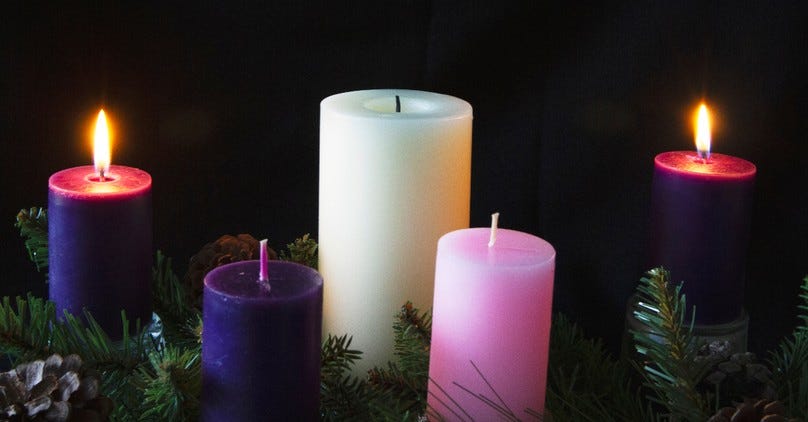
Advent is a call to wake up—the future is at hand. “Almighty God: keep us in the Eternal Now. Teach us that life will never have more or less of problems than now, never more of gladness and sorrow than now; that today is the day of salvation, the day to be and decide and to love.”
The divinity Christ reveals is already present—within and among humanity—yet its fullness still lies ahead. That tension sits at the heart of Advent.
History gives an image. At the end of World War II, D-Day marked the turning of the tide, while V-Day—the final victory—remained in the distance. The peace humanity longs for lives in a similar interval between what has begun and what is not yet complete. Shalom means wholeness: not just the absence of conflict but the presence of justice. In this waiting, the Spirit of Christ brings steadiness and confidence.
This is why the season leans toward songs of preparation—“In the Bleak Midwinter,” “Come, Thou Long Expected Jesus”—rather than the whole celebration of “Joy to the World.” Many hurry to the carols and miss the searching, almost austere beauty of the Advent hymns.
The season speaks of grace already at work and of promise still unfolding. It points to the birth in Bethlehem, which grounded God’s presence in history, and to the final Parousia (“Second Coming”), which will bring all things to completion.
In this view, we live between what God has already begun and the world as it now stands. That tension shows up both within us and around us, and it’s rarely a simple pull in two directions. Most of the time, we feel several currents at once, each tugging in its own way.
That’s true close to home. Each of us is more like a committee than a single voice—parent, partner, friend; faithful and doubtful; cautious and bold—members with competing claims and no obvious chair. As Orson Welles once said, “Everything about me is a contradiction, and so is everything about everybody else.” He wasn’t exaggerating. He was naming something we live with every day: we don’t resolve our oppositions so much as keep trying.
How, then, do we find peace in the middle of all this?
A surprising answer comes from Karen McCarthy Brown, the anthropologist of religion and leading interpreter of Haitian Vodou. Emerging from the blending of Catholicism with Western and Central African spirituality, Vodou has long been misunderstood—reduced to curses and zombies by Hollywood. What is lost is its essential nature as a tradition of healing, protection, and communal strength.
In places like Haiti, where hardship is constant, this faith has endured repeated efforts to suppress it, offering the resilience needed to survive.
Vodou doesn’t reject science or medicine; it sees them as too focused on curing pain or removing conflict rather than on how to move through them. It’s as if Vodou were saying, “We’re in a storm, and you think the point is to stay dry.”
I’m reminded of Jesus’s statement about coming to give peace—but not as the world gives it—saying, “I did not come to bring peace, but a sword.” The sword is not violence but the unavoidable conflict that follows when peace is mistaken for avoidance—or when people need an enemy to feel at peace at all.
Vodou approaches conflict differently: it works by engaging the forces that drive tension. Its rituals center on polyrhythmic drumming and dance.
Brown suggests that strength is “steadiness within a context of multiple rhythms,” responsiveness to the many “spirits” within and around us, anchored by a flexible but resilient sense of self. She uses a Creole term for the active listener or dancer in polyrhythmic music: balanser. The goal is to find an inner rhythm that can join and yet differ from the rhythms of the “others” both within and without.
Vodou ritual heals division not by forcing harmony but by letting contradictions find expression at once—human and divine, joy and sorrow, hope and fear.
This is not self-help but “spirit-help”: music and dance that seize and steady the self, as if by a muse. Einstein often said that his best ideas came from music. In Vodou, rhythm prepares understanding before explanation makes sense.
I’m no better at handling the tugs of friend, partner, parent, work, and the pulls of faith and doubt than I am at mastering the drums on YouTube, careful instruction and all. Try a polyrhythm—hands and feet moving in different patterns, each pulling against the other. Most days feel like that, only without the rhythm.
Watching and listening to a different harmony in conflict brings me a different kind of peace—something bordering on joy. Perhaps you, too, will feel the pull.
Advent is upon us.
A modern interpretation of West African Polyrhythms dating back over 1,000 years - 2:54 Use this hyperlink if the link below doesn’t work.
Notes and reading
Peace often begins by holding contradictions... —Peter Elbow, Embracing Contraries: Explorations in Learning and Teaching (1986), 252. Elbow is known for his emphasis on process, freewriting, and holding opposing perspectives. He is Professor Emeritus of English at the University of Massachusetts Amherst.
Advent: The Once and Future Coming of Jesus Christ — Rev. Fleming Rutledge (2018). Drawing on Scripture, patristics, Barth, Bonhoeffer, and modern theology, Rutledge is scholarly without being obscure for non-academics.
“Everything about me is a contradiction...”—Orson Welles, Interviews (2002), 14. Welles’s career was multidimensional and thoroughly interwoven with his persona.
Vodou
Karen McCarthy Brown (Drew University):
“Women’s Leadership in Haitian Vodou,” Weaving the Visions, ed. Judith Plaskow and Carol Christ (1989), 226-234. After ten years of researching Vodou, McCarthy Brown was initiated into the tradition.Mama Lola: A Vodou Priestess in Brooklyn (2011), Karen McCarthy Brown. Journal of the American Academy of Religion.
Brown was a respected anthropologist and scholar of religion, known for her groundbreaking work on Haitian Vodou.
Drumming and dancing in religious practice—For a broad account, see Catherine Bell, Ritual Theory, Ritual Practice (1992; reissued 2009), awarded “Best First Book in the History of Religions” by the American Academy of Religion.
Bell, a Professor of Religious Studies at Santa Clara University, became one of the preeminent scholars of ritual studies.
Additional note:
Philosopher Mikhail Bakhtin in the 1920s developed a view of culture and discourse translated as dialogized heteroglossia: the idea that meaning emerges not from silencing contradictions but from letting distinct voices interact, interrupt, and reshape one another—a dynamic especially germane to living Advent in the midst of competing tugs, rhythms, and selves.
You’ve got me singing “O Come, O Come, Emmanuel” and “On Jordan’s Banks the Baptist Cries” again. As you say, there’s a certain austerity and a searching (if not haunting) quality to many of these Advent hymns. This rich tone often feels more suited to the lived tension, from the standpoint of basic eschatology, between what has come and what’s coming. Honestly, I find more joy in these hymns (the two I name and the two you name) than in most Christmas carols, as much as I also love them. Perhaps these Advent songs bring something like the joy you experience listening actively to harmony in conflict.
Your essay also makes me start to realize that preparation is essential to freedom. Preparation is active hope—the last thing an unjust realm wants working in its people.
I’m glad to learn that the practitioners of Haitian Vodou have a term for an active listener. My own passivity—specifically, my uncritical acceptance of Western characterizations of Vodou—stems in part from my culture’s fear of the Other. Only the seeming contradiction of an “active listener” involves us as witnesses, the central concept, I believe, in what Arendt calls “juridical man.” In such a person or persons, the Other gains the potential of becoming something like what Elie Wiesel calls a “helper against,” based on his understanding of Eve’s calling in the Hebrew.
You and Advent are drawing out quite a bit from each other, William. I love it.