
Houyhnhnms vs. Yahoos
“Of so little weight are the greatest services to princes, when put into the balance with a refusal to gratify their passions.” ― Jonathan Swift, Gulliver’s Travels, 1726

In this age of bullshit, even irony is growing banal, and clever is wearing out. People are tired of being tired. It’s a good time for the truth.
Three hundred years after its publication, Jonathan Swift’s Gulliver’s Travels remains one of the masterpieces of satire in world literature. Written as a travel journal and often treated as an adventurous children’s story, it is comic enough to disarm, severe enough to wound.
Each section follows a different voyage of Lemuel Gulliver, an English ship’s surgeon who stumbles into bizarre, isolated societies: Lilliput, Brobdingnag, Laputa, and the land of the Houyhnhnms. Every destination offers a sharp critique of human nature, politics, and reason. Swift changes the scale so greatness no longer depends on size, power, conquest, or empire.
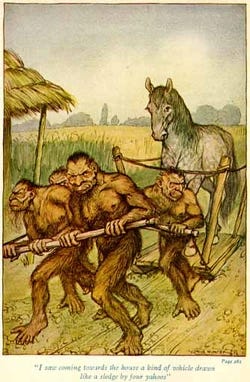
Gulliver’s last journey is to the land of the Houyhnhnms, horselike creatures with great intelligence, restraint, courtesy, and devotion to reason. Dreadful humanlike creatures called Yahoos instill in Gulliver a loathing of the human form. But the Houyhnhnms’ calm rationality masks horror. They whip and degrade the Yahoos, debate their destruction, and create the degraded conditions that make Yahoo inferiority obvious. Gulliver, awed by their order, loses his moral bearings so completely that he leaves in a boat partly made from Yahoo skin. Something has gone badly wrong.
By mistaking the Houyhnhnms for perfect creatures, Gulliver makes ordinary human life intolerable. He cannot bear the sight of his own family and feels at home only in the stables. Swift’s social criticism is not abstract misanthropy but a humane indictment of systems that make domination look reasonable.
After many years, I found relief from the news and read Swift’s classic again. No partisan of left or right, liberal or conservative, Swift despised the self-flattering party of progress: the Whigs. When Gulliver holds up perfect rationality as the human ideal and finds no one who meets it, he collapses into disgust. He sees humanity as little better than the ugly Yahoos. His faith in progress and reason turns into misanthropy.
Swift, an Anglican cleric who loved his people, stung readers into seeing the imitative habits of reason and the dangers of rationality without humility.
Today’s Houyhnhnms might be the AI gurus of Silicon Valley, apostles of would-be rationality. The public has grown used to warnings about artificial intelligence, children’s digital dependence, and students outsourcing work to machines. Whether we welcome, fear, or ignore AI, we face the fact: the vast growth of data centers and their demands on land, water, energy, and public life.
Within a few years, at a cost measured in power plants, water rights, transmission lines, tax breaks, and land once meant for other uses, AI may do more than assist intelligence. It may come close to defining it. In the process, it risks turning the rest of us into Yahoos—a role once reserved for “the deplorables” and MAGA enthusiasts.
It is easy to demonize AI and its luminaries as if the rest of us are not complicit. The dream of improving humanity can become the management of humanity. The prison need not arrive with chains. It may come as efficiency, comfort, moral certainty, and the promise that everything is arranged for our own good. We are told to adapt, optimize, move on, and keep up, as if grief meant clinging to what used to be or failing to let bygones be bygones.
“I want change, but not if it’s different.” Funny enough, until life changes. Rejecting false consolation can become its own kind of refusal, turning irony into an alibi, until “that sweet smoke dissolves in air.”
“Surely some revelation is at hand.” Those familiar lines from W.B. Yeats’s 1919 poem “The Second Coming” capture the feeling of a world where “things fall apart.” The poem ends with a question that leaves the age itself a riddle:
“And what rough beast, its hour come round at last,
Slouches towards Bethlehem to be born?”
The beast is not AI. We need not flee the machine or, like Gulliver, worship the horse. We can use tools without bowing to them. We can seek knowledge without giving up judgment, mourn without turning grief into weakness, and resist the passion that wants every person made useful, every loss made obsolete, every question turned into output.
Who are the Yahoos? Swift knew that princes do not need crowns. They need servants, flatterers, systems, and a public willing to trade judgment for ease. Gulliver’s final ruin shows what happens when false rationality and repeated misperception hollow out human feeling. He can flee humanity, worship the horse, and recoil from his family, but he still belongs to the world he despises. He cannot finally escape the Yahoos because he is one.
Service counts for little when a prince wants consent. The test comes when conscience refuses to gratify power.
Such refusal may carry little weight at court. It may be the only weight that matters. Even Gulliver had to go home.
Notes and reading
Caption: “I saw coming towards the house a kind of vehicle drawn like a sledge by four Yahoos.” - Part IV, Chapter II.
“that sweet smoke dissolves in air”—from a poem by A.N. Wilson, an English novelist, biographer, literary journalist, and cultural critic. The poem appears on his Substack on May 22, 2026.
Gulliver’s Travels: The Cambridge Anniversary Edition (May 14, 2026). “It is universally read, from the cabinet council to the nursery.” - Alexander Pope.
The Cambridge Companion to Gulliver’s Travels, edited by Daniel Cook and Nicholas Seager (2023), especially the chapter “Politics.” W.B. Yeats revered Swift’s “savage” moral force and returned repeatedly to his work. He saw Swift as a kind of mask or anti-self: “Swift haunts me; he is always just round the next corner.”
Swift as Priest and Satirist — edited by Todd C. Parker (2009), a volume examining how Swift’s priestly vocation shaped his satirical severity.
“Is AI Pushing Us Toward a Faceless Parasocial World in 2026?”—Akhilesh Kulkarni, Medium (December 25, 2025). Cambridge Dictionary named “parasocial” its 2025 Word of the Year. The term has surged as people form one-sided bonds with influencers, celebrities, podcasters, fictional characters, and now AI chatbots.
Swift is a perennial. His incisive gaze took in the follies of every "civilized" age.