
Hard Pluralism
The Tower of Babel

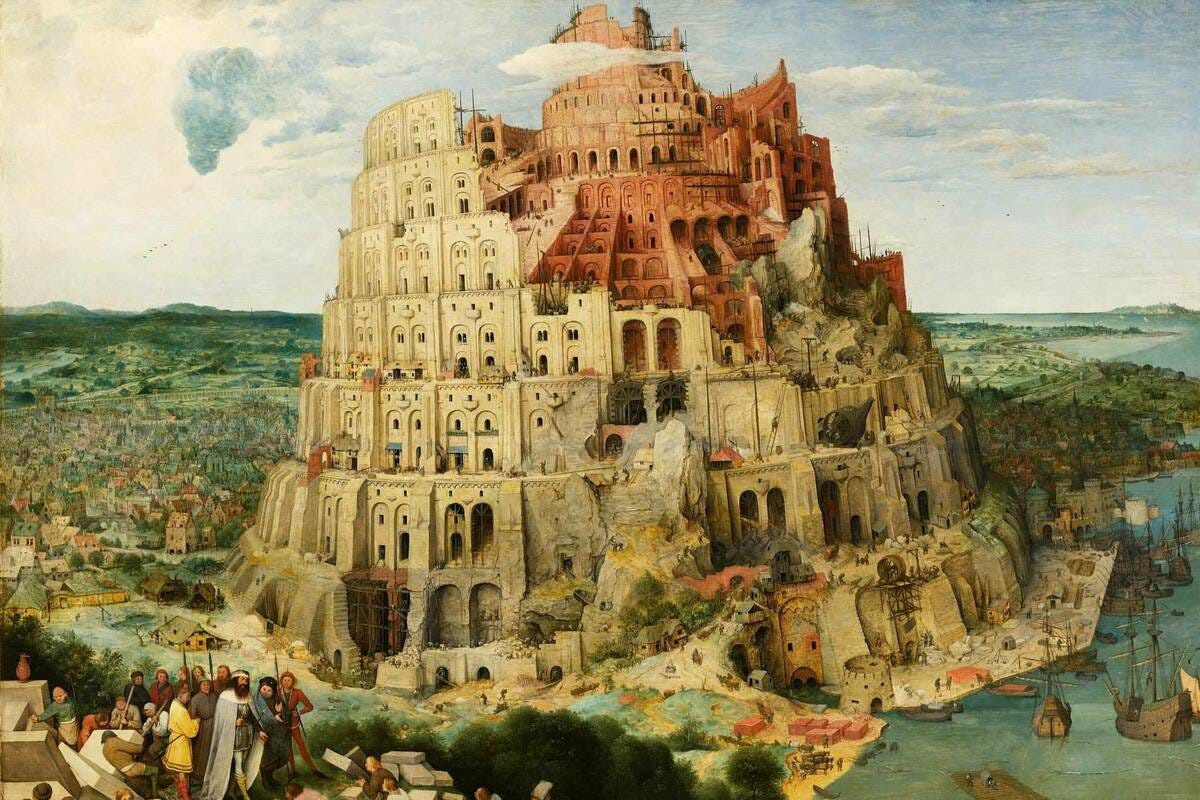
The urgency of current events can obscure lessons essential to democratic renewal.
Would we be better off if we understood one another better? Or would that make things worse? I’m not sure. Sometimes what we don’t know is what keeps us living together. “If I’d known you felt that way . . .”
To understand is to stand under something, not above it. The German verstehen resists the habit of treating understanding as mastery—a stance common in politics, administration, and moral discourse.
People often treat the Tower of Babel as a curse—“babble.” It can also be read as a blessing. We are spared the illusion of total understanding and the pressure to be the same, or to imagine we know more than we do. [*]
The tower falls, exposing the pretense of unlimited unity. Pentecost does not reverse Babel; it shows difference without collapse. People are understood “in their own native tongue.” They do not return to one language or one mind, but remain distinct—recognized as they are.
Babel and Pentecost, read this way, are lessons in restraint. Mutual intelligibility does not require uniformity. Understanding does not erase difference; it makes room for it.
Here, politics enters. Liberalism errs when agreement is treated as a moral achievement rather than a temporary outcome. When consensus proves legitimacy, disagreement becomes a failure of understanding—or of good faith.
In a diverse world, disagreement is not a defect. It is evidence of real differences among real people. Any power to suppress others’ views must be one we would accept turned against our own.
When politics tries to eliminate friction, persuasion gives way to sameness in the name of the common good. Hannah Arendt saw this clearly. In The Human Condition, she writes that plurality is not simply the presence of many but the fact that each arrives as someone new—capable of beginning the unforeseen. Each of us is unique. Inversion of the U.S. motto: E unum pluribus.
In this view, differences are not flattened but disclosed. “Only the full experience of this capacity,” Arendt writes, “can bestow upon human affairs faith and hope.”
This yields a tougher pluralism—easily mistaken for intolerance or reduced to manners. We are told to “disagree without being disagreeable.” The advice sounds virtuous; it often means: “dial it back.” “Hate the sin, not the sinner” sounds charitable, but it can drain disagreement of consequence.
When leaders act with cruelty or contempt, calls for open-mindedness ring thin. What divides us matters as much as what unites us. Pluralism fails when respect becomes tolerance, tolerance becomes rule-following, and rule-following replaces judgment. Politeness substitutes for civility, process for persuasion, openness for performance—Black tie optional. Rehearsed. Scripted. Attendance expected.
I have seen this in civic meetings, churches, and campuses. Disagreement is welcomed in principle but managed in practice. Tone is monitored. Language softened. Objections acknowledged, then set aside—not for what is said, but for how it is said. No one is silenced outright. Dissent is permitted, then neutralized. Conflict is allowed only as long as it does not disturb the outcome. Good taste.
Hard pluralism begins elsewhere. Democracy does not require harmony—still less consensus—to endure; it requires the courage to face disagreement without draining it of force. It depends on distinguishing between dissent and disloyalty, civility and safety, and courtesy and legitimacy. This is harder than enforcing rules and riskier than managing tone. It asks institutions to persuade rather than contain, and citizens to remain when withdrawal would be easier.
Political theorist and historian of civility Teresa Bejan warned early in the Trump years that the greater danger was not crude speech or even deceit but the use of power to end argument. Ending disagreement by force and emptying it through control leads to the same place: conflict disappears, and with it responsibility. Or so it seems. What is suppressed returns—often stronger.
Pluralism fails not when disagreement endures, but when it is made inconsequential. Democracy decays not only when dissent is crushed, but when civility drains it of force.
The remaining work is modest and demanding: stay present, speak plainly, refuse to mistake quiet for consent. This does not resolve our differences. It keeps them visible. It keeps the future open.
Notes and reading
[*] The Tower of Babel, Genesis 11:1–9. In Jewish interpretation, Babel is less a curse than a restraint: God interrupts a dangerous unanimity that concentrates power and erases difference. The confusion of languages safeguards dissent, responsibility, and freedom—making plural life possible. (“So highly does the Holy One, blessed be He, value peace and so greatly does He reward the pursuers of peace.”)
—from Genesis Rabbah through the Maharal, cited with commentary in “Pluralism Ancient and Modern,” Commentary (December 1978).
Pentecost, Acts 2. “The Mystery of Language and the Mystery of Pentecost”—Andrew Kuiper, Church Life Journal (May 17, 2024).
The Human Condition—Hannah Arendt (1906–1975). 2001 ed. The definitive source on her concept of “plurality,” the irreducible distinctness of persons in political life, not to be confused with the later doctrinal “pluralism.” See Chapter 1 (“Introduction”) and Chapter 24 (“The Disclosure of the Agent in Speech and Action”).
No Offense: Civil Religion and Protestant Taste (1987); The Ordeal of Civility (1978)—John Murray Cuddihy (1935–2015). Protestant norms of sincerity and restraint shaped liberal civility, often turning pluralism into decorum and casting dissent as impropriety. Civility conceals a regime of taste.
Beyond Empathy and Inclusion—Mary F. Scudder (2020). Listening is a democratic act with force independent of agreement. Empathy may humanize; listening democratizes. Empathy can turn deliberation into self-display, remaking the other in one’s own image and reinforcing in-groups. If empathy sentimentalizes politics, inclusion proceduralizes it. Democratic vitality depends on exposure to disagreement—not mere demographic breadth.
“You don’t have to be nice to political opponents. But you do have to talk to them”—Teresa Bejan, The Washington Post (March 8, 2017); see also Mere Civility (2017). Bejan retrieves rival traditions of civility (Hobbes, Locke, Roger Williams—the “father of American pluralism”) to defend disagreement without coercion.
Solidarity: The Past, Present, and Future of a World-Changing Idea (2025)—Leah Hunt-Hendrix and Astra Taylor. Distinguishes solidarity from unity, and alliance from consensus, grounding democratic cooperation in difference rather than agreement.
Your opening pair of questions and your appropriately ambivalent answer to them points to something like what anthropologist Valentina Napolitano calls “the realm of the just and the impersonal,” something I associate with the “unstructured” (i.e., adult-free) play of elementary-school-age children as Richard Sennett has described it.
Children, Sennett says, make rules more complex to give younger or less-skilled children a handicap and so prolong the game. Rules are adjusted during the game for the same reason. The children recognize these agreements as what you describe as “a temporary outcome” and not as “a moral achievement.”
Once we are in the realm of the impersonal, we can argue and carry on as much as, say, opposing lawyers before a jury that they don’t wish to needlessly offend. Afterwards, the same lawyers can laugh and carry on in camaraderie or even friendship on the elevator down from the courtroom. I wish this kind of courtroom artifice were more prevalent in other areas of what we call the public realm.
One of our greatest losses in public life may be convention, which Sennett promotes as “the single most expressive tool of public life. But in an age where intimate relations determine what shall be believable, conventions, artifices, and rules appear only to get in the way of revealing oneself to another . . .”
And with appropriate public conventions, we maintain (and perhaps even foster) relations and public life itself. As you say, “Sometimes what we don’t know is what keeps us living together.”
Your concept of hard pluralism seems like the summit of, or at least a significant milestone in, a recurring examination that you engage in so profitably: how can we can maintain pluralism and its modes—dissent, civility, and content, among others—in an age that expects either force or an insistence on manners to devalue and suppress dissent.
Several of your lines capture some of these tensions in wonderfully exacting language that challenges us to think what a love for democracy really entails:
Democracy “depends on distinguishing between dissent and disloyalty, civility and safety, and courtesy and legitimacy.”
“Pluralism fails when respect becomes tolerance, tolerance becomes rule-following, and rule-following replaces judgment.”
“Pluralism fails not when disagreement endures, but when it is made inconsequential. Democracy decays not only when dissent is crushed, but when civility drains it of force.”
Here’s to hard pluralism. May we value the impersonal enough to become, maybe for the first time, Emerson’s “nation of friends.”
This post Hard pluralism is a resource for the vocabulary to notice if you are listening or if you start making faces and huffing and chittering like a monkey you know tsk tsk you have gone into childmode. Actions are what ropes us to political slavery to the hottakes. Listening's an action. And indeed we feel sure that most donot wish for insinuations shoehorned into process politesse to make our group decisions for us. Dangerously a giant tranche of us appear now 80 plus percent of americans i see appear to be a people who cannot stop talking. In prayerful hope that our tradition of standoffishness returns, maybe for us Never stop-talking just takes place as a fad.