
Stand by Me
The defense of virtue.

Goodness is trusted when it can protect itself and admired when it delivers results. When it cannot, it is often dismissed as naïve. Some virtues are recognized only in hindsight. What looks foolish in the moment may simply arrive before its time.
A ceasefire often slips by without notice because it isn’t dramatic. There’s no clear winner or loser, nothing memorable to replay. It can look weak. If peace lasts, people forget the restraint, as if nothing happened. Other times, restraint ends with someone claiming victory, the other side feeling embarrassed, and images abound.
We see this same pattern in everyday life. Restraint might mean not sending a harsh email, letting a misunderstanding go, or holding back from explaining yourself again. In each case, restraint is visible only in the trouble that never happens. That’s why it’s easy to miss—and rarely credited.
Dostoevsky’s The Idiot explores this problem through a form of goodness that doesn’t leave a mark or seek praise. The novel attempts to portray a “positively good man” in the modern world, though Dostoevsky himself doubted such a figure could survive it. Prince Myshkin doesn’t try to control anyone, and people judge him for that. His honesty looks like weakness, his trust like foolishness. Because he avoids social games, others take advantage of him. That is why he is called the idiot.
With Myshkin, goodness doesn’t just fail to persuade—it unsettles. His openness reveals others’ motives without accusation. He is seen as dangerous because he refuses to compete. By not defending himself, he leaves others feeling quietly judged. In the story, innocence does not protect him. It accelerates the harm he faces.
There is another irony. Myshkin has epilepsy—something Dostoevsky also experienced—and he receives moments of intense clarity just before his seizures. These insights do not help him get ahead. He cannot turn them into leverage or control. Even when he sees clearly, he refuses to use that knowledge. His goodness remains defenseless.
He might have done better had he appeared more capable—managing his image, putting on a show, or claiming success early. People would have found it easier to connect with that version of him. Something similar happens in public life. Sometimes that’s wise. “No Kings Day,” like some later protests, relied on playfulness and spectacle to reflect—rather than confront—the chaos in Washington. Comedy becomes a way to handle disorder without facing it directly.
It is often said that a good leader must be a character. If you tell the truth, add a joke. Earnestness is frequently the least effective posture. When those in power turn everything into a spectacle, serious opposition risks becoming part of the act. Used carefully, ridicule can refuse to treat the show as seriously as it demands.
As G. K. Chesterton once observed:
“Solemnity flows out of men naturally, but laughter is a leap. It is easy to be heavy: hard to be light. Satan fell by the force of gravity.”
The Idiot is a satire without irony. Dostoevsky is not mocking the world; he is showing what happens when the world laughs at goodness and comes out on top. Myshkin is not ridiculed for being good, but tested by a culture that confuses showmanship with intelligence and irony with depth. He does not fail because he misunderstands others, but because he refuses to use insight for gain. His sincerity is not a tactic, and so it is taken for foolishness.
A culture devoted to spectacle will almost always misunderstand virtue that refuses to defend itself. Some truths appear without protection. Some virtues do not last in their own time. Still, they are not wasted. They remain as a quiet standard—unchanged, unsettling, able to reveal the noise for what it is.
That may not be enough to win the day.
But it may be enough to keep the moment from winning us.
Sometimes, that is how goodness keeps its hold.
Sometimes that is how goodness sings.
An old hit, resonant today. Prince Royce’s version of “Stand by Me” blends English and Spanish lyrics. (3:48) - Lyrics
Notes and reading
Prince Royce’s bachata version of Ben E. King’s classic reworks the song within a Latin rhythmic framework. “Bachata” originated in the Dominican Republic in the mid-20th century as working-class popular music, marked by a steady dance rhythm and an intimate, confessional tone, later becoming global. Prince Royce also collaborated early in the career of now Grammy-winning Puerto Rican artist Bad Bunny.
Fyodor Dostoevsky, The Idiot (1868; Oxford edition translated by Alan Myers, 1998). Often described as the most personal of Dostoevsky’s major works, embodying his most intimate convictions.
Mikhail Bakhtin, Problems of Dostoevsky’s Poetics (English edition, 1973). Bakhtin described meaning as dialogical—emerging through the interaction of voices, including silence—rather than “monological.” He saw Dostoevsky’s novels as among the clearest expressions of this approach.
Neil Postman, Amusing Ourselves to Death (2005). A foundational critique of how media reshapes public discourse through entertainment and spectacle.
Nevile Henderson, Failure of a Mission (2010). Henderson, British ambassador to Germany from 1937 to 1939, offers a firsthand account of British diplomacy during the final years of appeasement. Though his judgments are widely regarded as mistaken in hindsight, the memoir remains an important primary source, showing the moral seriousness, strategic restraint, and self-deception that can shape political policy.
Elif Batuman, The Idiot (2017). Batuman’s novel can be read as a foil to Dostoevsky’s. Her Selin meets the world through irony—an intelligence shaped by distance, ambiguity, and self-preservation. Prince Myshkin does not. Selin’s irony is part of her intelligence; Myshkin’s lack of it is part of his tragedy.
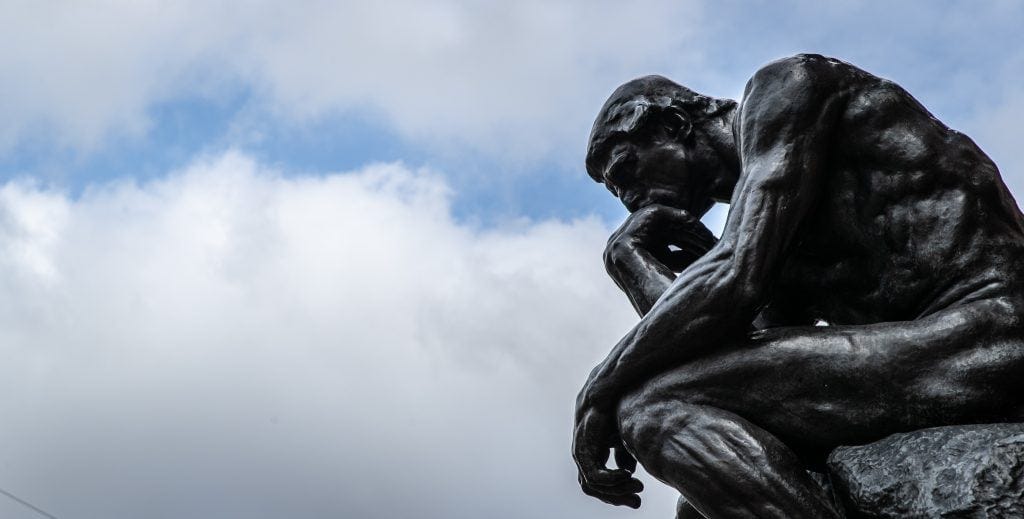
Jeff Wall’s 1986 photograph The Thinker is distinct from Auguste Rodin’s 1904 bronze The Thinker (Le Penseur), with which it is often confused.
You picture the necessary shadow side of public life, a life Hannah Arendt describes as "the place of appearance." Restraint gives appearance its chiaroscuro. Spectacle, contrasted with a such a fuller account of public life, is large and flat. True appearance allows us to work together, while spectacle, like Juvenal's circuses, dismisses us even before we watch.
One phenomenon of our times seems to be the recognized need to make living in our times three-dimensional. Rebecca Solnit writes about Orwell's need for a full private life. One reading of Thomas Hardy's poem "In Time of 'The Breaking of Nations'" does the same. Jesus invites his disciples to "Come away by yourselves to a secluded place and rest a while.” This acclimation doesn't need or resemble spectacle's acclamation. In public matters or in everyday life, as you demonstrate here, the deliberate silent spaces speak. They may often invite, too, as you suggest with your example of holding back from explaining ourselves again.
I love Chesterton's line. Laughter doesn't do away with warranted heaviness but often helps to fulfill it, as it does in a Shakespearean tragedy. In the context of your essay, laughter comes across a form of restraint or perhaps even a virtue on a par with restraint.
I must reread The Idiot, now with your framing in mind. I'm also bent on reading Bakhtin's Problems of Dostoevsky's Poetics.
Thank you for this thoughtful and timely reflection.