
Everybody Means Everybody
And, inconveniently, it includes us.

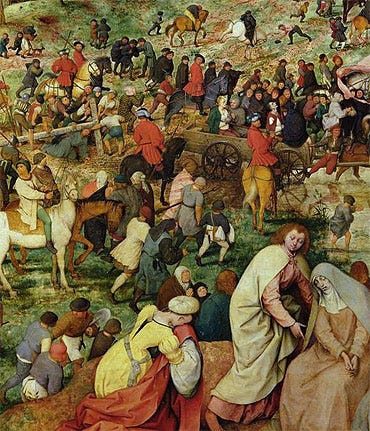
God is not somewhere above us, like a landlord in the attic. Salvation is not help arriving late from a hero buried in history. Christ comes not to rescue us from danger, but to invade the ordinary and make us more alive than we knew we could be.
The good news is for everyone—especially those who think they do not need it.
To some, Jesus is meek and mild; to others, harsh and judgmental. He can be difficult to hear and harder to hear about. Add the claim that Jesus is God, and many have headed for the exit.
Many object to the claim that everyone will finally be “saved.” Hell is part of what makes justice feel like justice. Some evils seem to demand more than punishment; they demand eternal perdition. If hell is temporary and heaven is creation’s final destiny, then even the deplorables and despicables are not finally beyond redemption.
And that includes us. The scandal is not that heaven contains the wrong people, but that we are among them.
Universal salvation is not the comforting thought that nothing matters. It is the alarming claim that no one can be dismissed. God’s refusal to abandon the wicked is not indulgence toward evil. Evil does not get to define anyone forever.
No one is required to feel equally concerned about everyone, and compassion can be exhausted. But no one becomes disposable because we are too tired to care. The world as we find it is evidence, not verdict. Reality is not the conclusion but the question, and the persistence of evil does not make it eternal.
Duration is not destiny.
Death can look final, violence victorious, sin capable of possessing a person. The Christian story turns on the conviction that none of these appearances is ultimate.
This sounds like a sermon has broken out. Not quite.
Jesus tells us to “be perfect,” but the word does not mean flawless. It means complete, no longer divided against ourselves. Wholeness, not moral fussiness. God sends rain on the just and the unjust without checking credentials. To become perfect is to become less divided, less selective in love, more fully what we were made to be.
We know we should be better. The harder claim is that God does not wait for us to become worthy before giving us what we need. Grace is the name for that unearned giving. It begins as gift. Even our ability to receive it comes by grace. It does not merely repair what has gone wrong. Grace reveals what was already given.
My prayer is simpler: not “O God, make me stronger, more loving, more trusting,” but “Thank you for what you have given. Help me receive it and do justice to it.”
This good news is not Christianity’s to keep. “Faith in Jesus” is more than accepting propositions about him or making him an object of devotion. It means entrusting ourselves to the life he shows and the God made known through him. This love comes before our worthiness and sustains us before we know to ask. Faith is trust that his life tells us something true about who we are becoming.
Such faith is tested by the life it produces. A faith that needs enemies, cannot risk doubt, or guards grace as its own possession is defending itself rather than trusting God. Better evidence is a life less anxious, less hostile, more capable of welcome.
Raised in a pastor’s household, Nietzsche put it with irony: Christians would have to sing better songs, he wrote, and look more redeemed before he could believe in their Redeemer. The taunt remains.
The philosopher Iris Murdoch, who called herself “not quite a believer,” made attention central. We fail to see what is already there, then search for it everywhere else. In Poe’s “The Purloined Letter,” the missing letter lies in plain sight. More colloquially, the lost key is where you left it.
Jesus was not a theologian. That could be our job. He told stories about farming and money, weddings and debts, difficult children and troublesome neighbors. Somewhere in the story, the expected order gives way.
What matters is what is last, little, least, and lost. Jesus turns toward those who fail by the world’s measures. Their weakness leaves room for another kind of strength. The despised Samaritan becomes the neighbor. The wounded stranger in the ditch becomes Christ.
This is no celebration of weakness, and suffering does not make anyone better. But strength that depends on superiority or the defeat of others is more fragile than it appears.
Jesus shows another kind of strength. It does not need to dominate or prove itself. It gives itself away, receives what the world overlooks, and finds life where wisdom expects failure. God’s power is love willing to enter suffering without surrendering to it—love that can lose everything and still give.
Strength is knowing what keeps us standing. The weak know they need help; the strong are in trouble when they forget it. Grace does not arrive when self-reliance fails. We discover it was there all along.
Salvation is creation fulfilled—and no one left out.
Notes and reading
[*] Pieter Bruegel the Elder, The Procession to Calvary (1564). Christ is nearly lost in the crowd as ordinary life continues around him. Redemption enters without forcing notice: Christ is already among the human multitude, not only among those who recognize him.
Athanasius of Alexandria (c. 296–373), early Church Father, On the Incarnation. Athanasius understood salvation not merely as rescue or pardon but as participation in divine life: God became human so that humanity might become divine.
Thomas Aquinas (1225–1274), Summa Theologiae. The stakes are nothing less than what salvation means. Are we created for salvation, or is salvation a destiny added to what we are by nature? A longstanding dispute asks whether later traditions sharpened Aquinas’s distinction between nature and grace too far, making salvation sound like an external addition rather than creation brought to its intended fulfillment.
David Bentley Hart, That All Shall Be Saved: Heaven, Hell, and Universal Salvation (2019). Hart argues that the Christian story remains coherent only if the God who creates all also finally restores all. Evil is real, judgment matters, but love is ultimate, and no creature is abandoned forever.
Aidan Kimel, “When God Becomes Jack Bauer: Torture, Hell, and the Greater Good” (2022; republished August 8, 2026). Drawing on Hart, Kimel argues that evil may be permitted only if it is finally overcome. An eternal hell would make irredeemable suffering part of creation’s final order—and therefore part of what creation reveals about God. “Love could not bear that.”
Iris Murdoch, The Sovereignty of Good (1970). Murdoch locates moral transformation less in will than in attention: learning to see beyond ego, fantasy, fear, and self-interest. Goodness begins in seeing reality more truthfully.
Editorial note: I sometimes use AI-assisted tools for proofreading, clarification, and revision. The ideas, judgments, and final wording remain my own.
A taut and flexible exploration of what the Bible’s claim that all will be saved demands of us. As the essay goes on, the topic seems to move from grace to faith to strength, but the topic never really shifts. So much of the essay’s force lies in the paragraph breaks. The essay asks us to move across them as along the most demanding of straits.
Thank God for bones, but “every joint supplies.”
But them bones! Some of my favorites among your inviting and demanding stunners:
“Faith is trust that his life tells us something true about who we are becoming.”
“Duration is not destiny.”
“What matters is what is last, little, least, and lost.”
Perhaps it takes an individualist society to believe that someone’s punishment, much like my considered opinion of someone, can last forever. Retributive justice itself is a lazy concept, a kind of othering that creates a community through survival and implicit hierarchy, a community of those not voted off the island—at least not during this television season. The news that all shall be saved is tough grace: I must address the gulf that I myself have fixed between me and the beggars at my door.