
Against Resolution
The ending was clear until the next thing happened.

E. B. White said, “I arise in the morning torn between a desire to save the world and a desire to savor the world. This makes it hard to plan the day.”
A war has widened overnight. A scandal breaks and instantly becomes a verdict. Markets rise on bad news and fall on good. A video of suffering appears between an ad for skin cream and a clip of someone dancing in an airport.
The weather is ominous. Technology astonishes. Politics is deranged. The day has barely begun.
Then someone sends a joke.
I laugh, then wonder whether I should have. Grief and absurdity share the same screen. Hope and despair appear side by side. As Alice said in Wonderland, “It would be so nice if something would make sense for a change.”
Events overlap, interrupt, contradict, and refuse to resolve before the next arrives. “Organized incoherence” sounds like an accusation but describes the condition well. What has changed is how fast these contradictions reach us.
Satire is the new sincerity.
A concert by Phish, the celebrated improvisational rock band, offers a benign version. A song begins, wanders into improvisation, and seems to lose track of where it came from. The through line disappears. Not ideal for readers who insist that 2 + 2 = 4.
Yet the musicians listen. Beneath the wandering lies attention. A phrase returns altered. A rhythm gathers. What sounded like disintegration becomes exploration.
Incoherence rhymes.
The jazz great Thelonious Monk is often credited with saying that a wrong note depends on what comes after it. A mistake does not end the performance. The next note exposes the error or folds it into a pattern no one intended.
Current politics offers a harsher version. The same act becomes tyranny when the other side commits it and necessity when one’s own side does. Incoherence is not a mistake in the performance. It is often the performance.
Technology promises to remove friction, but much of that friction comes from other people, with their delays, awkwardness, needs, and unpredictability. Screens and algorithms spare us this organized incoherence, then weaken some of the capacities it forms: reading a face, tolerating uncertainty, finding our way, and making judgments no device can make for us.
Convenience, n. The removal of every difficulty except those it creates.
Yet incoherence does not always lead to collapse. Conflict can give a system staying power as opposing forces check and sustain one another. A suspension bridge stands because its tensions are held in balance; remove them, and the structure fails.
And so with a household. The differences that cause friction may also distribute burdens no one person could carry alone. Fragmentation and integration occur together. The pressures that divide people may also bind them into new forms of dependence.
Thucydides, the great historian of war and power, saw that even justice arrives entangled in incoherence. The strong call domination necessity. The weak assume righteousness guarantees rescue. Both mistake fear and pride, self-interest and desire, for clear judgment.
Justice remains real, but its claims are never free of interest. We are quickest to demand justice when it requires someone else to yield.
Coherence is a discipline of thought, not the discovery of a perfectly ordered world. Experience need not fit together neatly for contradiction to remain contradiction rather than depth.
Incoherence blurs the lines between serious and trivial, public and personal, tragedy and comedy. It entangles justice with interest and principle with self-deception. Everything must be judged at once, and then the day goes on.
The result is numbness or frenzy. Despair sometimes passes for lucidity because exhaustion has begun to feel like insight. Declaring the world meaningless reduces its mystery to our disappointment.
Meaning changes as our relation to the world changes. The desire for permanent resolution can become a refusal to deal with what is still taking shape. When familiar meanings fade, the emptiness they leave can become an opening.
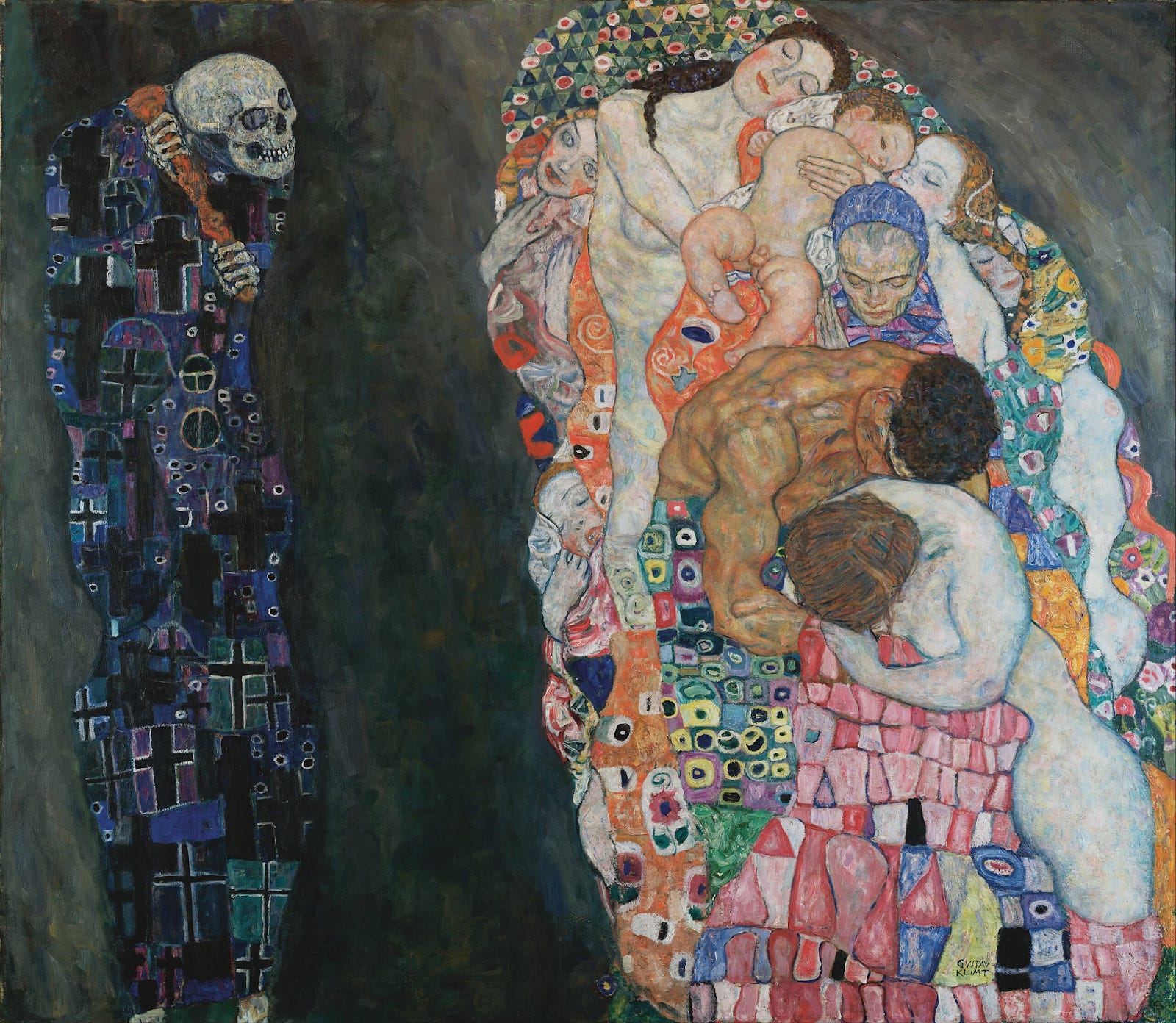
Gustav Klimt’s Death and Life gathers human incoherence into a single image. Lovers, a mother and child, an old woman, and a crowd of bodies form a bright mosaic of attachment and vulnerability. Death waits at the edge, grinning beneath a cloak patterned with crosses and graves.
I have never seen death as the last word in the painting. Each birth brings someone into the world who has never appeared before, capable of interrupting what seemed inevitable and beginning what no pattern could predict. Mortality sets a limit but does not exhaust the meaning of a life. People fail and recover, break and mend, and die while life continues in beginnings they will never see.
Ruin does not have the last word. Cruelty can destroy, but even cruelty depends on powers it did not create: intelligence, freedom, desire, and life.
Coherence never existed in the form nostalgia assigns it. It is the story the past tells after editing out confusion. Things were not better then, simply farther away.
Life is closer to improvisation, with ideas introduced and abandoned, mistakes repeated, old patterns returning in new forms. I am not who I was. What matters is attention within the confusion: knowing noise from warning, spectacle from suffering, novelty from change, despair from honesty, hope from denial.
The next note will not redeem the last, but it can change what comes next—not a clean ending, but a new beginning.
Notes and reading
Alice in Wonderland—The line is spoken by Alice in Walt Disney’s animated film Alice in Wonderland (1951), rather than in Lewis Carroll’s original books.
Phish—An American rock band known for treating songs as open forms. Concerts vary from night to night, with long improvisations in which repetition, detour, and return become the structure rather than departures from it.
Thelonious Monk: The Life and Times of an American Original—Robin D. G. Kelley (2010). Kelley’s biography presents Monk as a rigorous composer whose silences, dissonances, and angular rhythms reflect a highly deliberate musical intelligence.
Thucydides—“Thucydides the Perspicacious,” Aeon (August 3, 2026). The great historian’s realism lies in exposing self-deception. Far from believing that might makes right, Thucydides shows how the strong call force wisdom and the weak call justice rescue. Both mistake desire for judgment.
Mary Catherine Bateson—Composing a Life (1989). The cultural anthropologist sees identity as an improvisational achievement. People become who they are by making creative use of discontinuity and change.
August 5, 2026—On the eve of the Hiroshima anniversary, Ray Bradbury’s “There Will Come Soft Rains,” published seventy-six years ago in 1950, reaches the date on which it ends. An automated house continues serving a family reduced to silhouettes on an outside wall. A falling branch starts a fire, and its intricate order collapses into “maniac confusion, yet unity.” Even a settled ending can be unsettled:
Dawn showed faintly in the east. Among the ruins, one wall stood alone. Within the wall, a last voice repeated: “Today is August 5, 2026, today is August 5, 2026, today is . . .”
A lighter note
Company in Confusion—After receiving a brilliant student’s paper, a prominent professor said, “I can’t grade this. It’s too difficult, too obscure.” He gave it to a colleague of comparable renown. “Well,” the colleague said, “it’s either an F or an A+.” The New Yorker (August 3, 2026), 57.
Editorial note: I sometimes use AI-assisted tools for proofreading, clarification, and revision. The ideas, judgments, and final wording remain my own.
Your account of incoherence as (in part) an invitation to wait, to respond, and to await our response’s rejoinder resonates. The last word doesn’t fix meaning but avoids it. Your post reminds me of Anne E. Berthoff’s concept of composition as a form of meaning-making: “We do not ‘have’ meanings that we then put into words. . . . We discover meaning in the process of working and playing with the means language provides.” Or, as she puts it more aphoristically, “One of the chief meanings of ‘meaning’ is ‘mediation,’ or the ‘means by which.’” Meaning as mediation = jazz.
Your post does what it discusses: it puts off closure. I would describe your post as I.A. Richards describes a book: “a machine to think with.” Or maybe a book as a game of cards, as Richards connects them: “One does not expect novel cards when playing so traditional a game; it is the hand which matters.”
Your post in this analogy amounts to a winning hand. Or rather, since the game, like music, must be played, a promising hand.
By the way, The New Yorker’s review of Emily Eakin’s The Frenchmen: or, My Life in Theory (from which William draws the F or A+ incident in his “Notes and reading”) makes me want to read the book. The Frenchmen sounds a bit like Sarah Bakewell’s At the Existentialist Café: Freedom, Being and Apricot Cocktails—a way to learn theory in the context of the fellowship of those first advancing it.