
Careless Responsibility
The scandal is not who gets in, but who is invited.

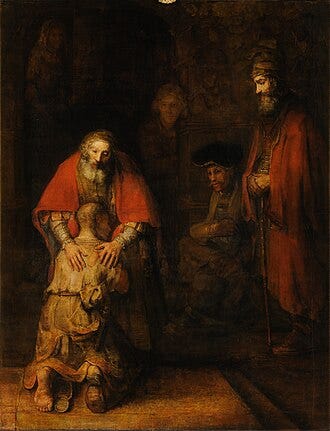
The last posts considered death and “immortality projects,” then Odysseus as a conservative hero of restoration. This one turns to the Prodigal Son—and to the claims of morality.
We’ve lost all sense of right and wrong in a culture without God.
So goes the complaint.
Liberals get blamed for moral drift. Conservatives get called self-righteous. Once God enters the argument, everyone agrees that God opposes bad people. Jesus turns the other cheek but stays on our side against those we dislike.
The truth helps no one. Every culture has been corrupt, even when it produced good. Greek writers complained that the young lacked discipline. Plato described rulers devoted to wealth and ease.
Faith can give this habit divine force. Each age mistakes its anxieties for God’s judgment. Religion gives us a God who shares our enemies.
Jesus’ parables refuse to cooperate. They place God on the wrong side of our moral accounts. Few do so more than the story of the Prodigal Son.
The story is familiar. A younger son takes his inheritance, leaves home, and wastes it. When hunger drives him back, his father runs to meet him and orders a feast. The older son, who stayed and worked, refuses to join the celebration.
But this is not merely a touching story about a wayward son who comes to his senses. It is a scandal about grace.
The usual lesson is true, but it lets us off too soon. We identify with the son who needs forgiveness and ignore the son with a claim. We admire the father without asking whether he is fair. Reconciliation becomes a feeling instead of a change in how people live together.
The parable is more demanding than that.
The father hears the younger son’s confession but will not let repentance become a bargain. He restores him in public and orders a feast that may draw the village. The older son sees this. He obeyed while his brother wasted what he had been given. Now the household celebrates the one who harmed it.
The father sees the pain of the son who returned. The brother sees the damage he caused. Each sees something true, but neither sees enough. The father takes responsibility for a family neither son can repair.
That responsibility looks careless because it ignores what people deserve. The father risks shame by running. He forgives before change has been proved. He celebrates before the damage has been faced. Yet he is careless only about the accounting that has made life together impossible.
The younger son says he is no longer worthy to be called a son. The older says, “All these years I have been working like a slave for you.” One leaves through rebellion. The other leaves through obedience hardened into entitlement. Both think belonging must be earned.
The father will not let either earn or lose his place. He restores the younger son and tells the older, “Son, you are always with me, and all that is mine is yours.” He denies neither failure nor faithfulness, but he lets neither have the last word.
The parable leaves the conflict unresolved.
The younger son enters the feast. The older stays outside, armed with virtue and wounded by mercy. The father goes to each, but he forces neither across the door. Reconciliation can look like irresponsibility. The line between the deserving and the undeserving may have to break before healing can begin.
That is not moral indifference. Celebration is not acquittal. The embrace does not erase the past. It keeps the past from owning the future.
Perhaps this is the carelessness of God: not carelessness toward injury, but refusal to treat any division as final. God does not wait for the guilty to become lovable or the resentful to become gracious. God does not wait for agreement on where everyone should sit.
The father tells the older son that he belongs. He rejoices because the younger has come home. God refuses the sides the brothers have drawn.
Jesus leaves us at the door with the older brother. Can we accept mercy for someone else before our own grievance has been settled?
The older brother thinks the scandal is that the undeserving have been welcomed. The greater scandal is that he must enter with them. Grace offends him because it includes those he would exclude.
The door stays open. The joke, if we can bear it, is that the one outside is home already.
It is easier to assign guilt or admit it because guilt can be managed. Responsibility remains after everyone has made a case for innocence.
Conservatives fail when they mistake punishment for seriousness and exclusion for faithfulness. Liberals fail when they treat compassion as enough and assume that understanding an injury repairs it. Each sees what the other avoids.
The father enjoys no such innocence. He goes out to both sons and bears the cost of keeping the family open. The God in this parable is harder to use. God will not stay on our side of the door. The father stands outside, pleading with the son who believes himself right. Inside, the feast has begun.
Reconciliation is offered whether we want it or not. Some have said, if that is heaven, give me hell. Anger offers an exit. Despair does too. The task is to enter a joy we did not authorize with people we did not choose.
Notes and reading
Parable—Luke 15:11–32. Some Christian interpreters allegorized the two sons as Gentiles and Jews, an identification that could reduce the elder brother to a supersessionist, anti-Jewish type. More careful readings preserve the sharper point: both sons are estranged, one by rebellion and the other by obedience hardened into entitlement.
Morality in the flesh. The father does not answer the family’s crisis with a principle. He runs, embraces, clothes, feeds, and goes out again to plead with the elder son. The moral meaning of the parable resides in these acts: responsibility becomes bodily presence, and reconciliation becomes a table at which estranged people must learn to live together. Grace is not an exception to morality but morality restored to its human purpose.
The Ox-Herder and the Good Shepherd: Finding Christ on the Buddha’s Path—Addison Hodges Hart, 2013. Hart brings the Zen ox-herding tradition into conversation with Christ the Good Shepherd. Both, he argues, portray spiritual life as a recovery of the self from estrangement, an inward transformation that issues in a more natural and loving life. Read beside the Prodigal Son, this illuminates “coming to himself” as the beginning of return rather than regret alone.
The Uni-Context: One World, One Moral Room—Agnes Callard. “The world is flat,” McDonaldization, homogenization, and unipolarity describe economic, cultural, or political convergence. Callard’s more radical claim concerns norms: once-distinct contexts—home, church, friendship, public life—collapse into one moral arena governed by standards meant to apply everywhere.
The elder brother already inhabits the uni-context. He turns the household into a ledger: obedience merits reward, betrayal its cost. The father does not deny the difference. He refuses to let a universal ranking determine his responsibility to either son. His response resembles Aristotelian phronesis: the fitting good discerned within a particular relationship. Callard’s novelty lies less in the remedy than in naming the conditions now eroding it.
Callard develops the idea in “A Philosopher’s One-Word Theory to Explain Why the World Feels So Weird,” her July 14, 2026, conversation with Derek Thompson on Plain English. A philosopher of ancient thought and ethics, she is the author of Open Socrates: The Case for a Philosophical Life.
Editorial note: I sometimes use AI-assisted tools for proofreading, clarification, and revision. The ideas, judgments, and final wording remain my own. More on that distinction in my next post, “The Singularity, Apparently,” coming shortly.
Reading your excellent post, I realized why the father may have clarified the final disposition of his goods: “All that I have is yours.” That is, your brother has already received his share.
It’s hard to make anything allegorical (theologically allegorical, anyway) out of that. Perhaps the father’s testamentary remark invites us to look beyond allegory to precisely the messy family and community relationships that the parable rather directly (surprisingly directly, I guess, for a parable) address.
And which you here address so well. Here are four of my favorite among your observations:
"The embrace does not erase the past. It keeps the past from owning the future."
"[B]oth sons are estranged, one by rebellion and the other by obedience hardened into entitlement."
"The joke, if we can bear it, is that the one outside is home already."
Yes! But do I really get it? I know I'll have to sit with that one for a while.
"It is easier to assign guilt or admit it because guilt can be managed. Responsibility remains after everyone has made a case for innocence."
So true! We can’t manage responsibility, grace or even love. Sexual attraction and even romantic love is often an absurd heightening, in this respect, of what all love is.
The other absurd heightening is death, which the father foresees in addressing the inheritance of each son.
So many die unreconciled to family members. Some relish the thought of such a death. One of our family members asked one of us to contact his siblings after his death to make sure they understood that they were not invited to his funeral. The phone calls, though, surprised no one except us. Each was a surprising reacquaintance and celebration in its own right.
Another one of our family members dutifully cared for their father for years as the other siblings ignored him. When he died, these other siblings sought their share of the inheritance, only to learn of a recent will in which the father left everything to his dutiful child. You can imagine the accusations that flew among the siblings.
These two accounts almost read to me like parables. As life goes on, I realize I’ve been too quick to use Jesus' parable to reinforce, though allegory, my theological leanings. Grace doesn’t need allegory to offend.