
Babel in Barcelona
A cosmic inversion of the Tower of Babel.

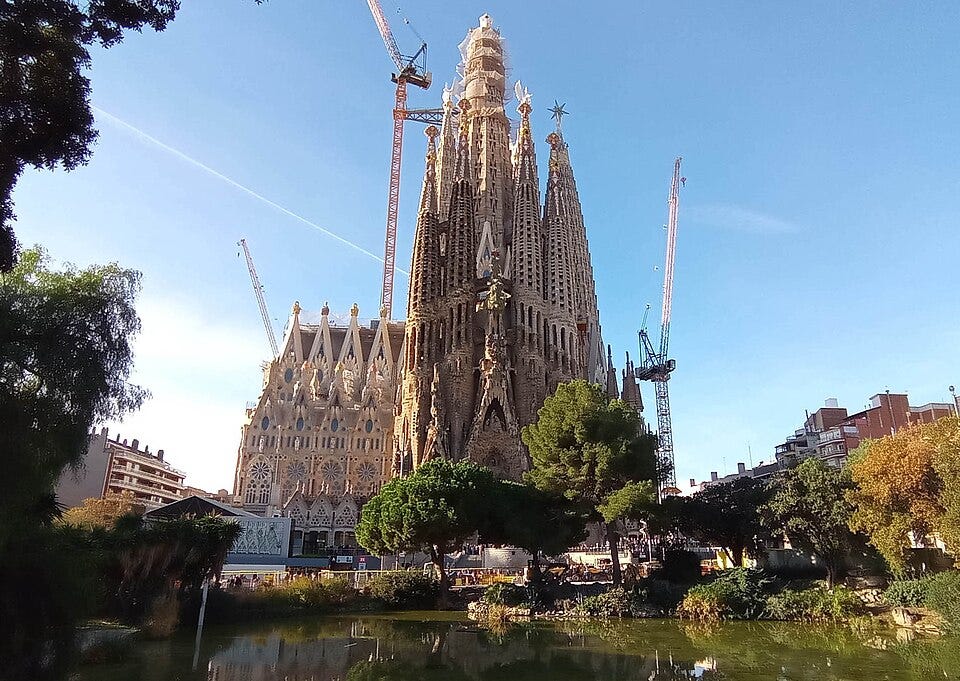

After finishing this reflection, I discovered that Gaudí is suddenly everywhere: the centennial of his death, Pope Leo XIV’s visit to the Sagrada Família, and a new surge of attention to the basilica’s long-delayed completion. So much for writing quietly about a spectacle.
Barcelona’s Basilica of the Sagrada Família is nearing completion, the magnum opus of the Catalan architect and designer Antoni Gaudí, who died 100 years ago. According to one biographer, Gaudí’s ambition was to write the Bible in stone.
Full completion is targeted for 2034 at an estimated cost of $400 million. The project is funded entirely by donations and visitor admissions. About 1,600 people work at the temple and its two stone-processing workshops.
The structure weighs nearly 220,500 U.S. tons and uses fifty types of stone, from red granite porphyry and black basalt to grey granite and yellowish sedimentary sandstone. It also includes stainless steel, high-strength concrete, and enameled white ceramic cladding. All are shaped with digital design tools and 3D printers Gaudí could never have imagined.
Its central Tower of Jesus Christ, the tallest spire, reached its full height of 172.5 meters, or 566 feet, on February 20, 2026, making it the tallest church in the world.
Still, its achievement is not height. Babel already tried that. Gaudí’s harder wager was scale without domination: immensity that returns us to attention.
The Sagrada Família is a cosmic inversion of the Tower of Babel: not humanity storming heaven, but stone, light, creature, craft, and prayer rising into praise. Not confusion multiplied, but multiplicity gathered.
Today, the church is Spain’s most visited tourist attraction. Locals have protested the crowds by squirting tourists with water guns. One recent visitor described a scene almost as surreal as Gaudí’s carvings: jazz from a brass band, giant bubbles, and clowns selling balloon animals outside the basilica.
The protesters with water guns are not merely being cranky. They are registering a loss: silence, which religious architecture was meant to offer. A place where the world recedes enough for something else to be heard.
Gaudí wanted to carve the Christian story into stone: every creature, every mystery, every hope. In some sense, he succeeded. The building is theological, a sermon in geometry. But you cannot receive that sermon with a jazz band and clowns selling balloon animals nearby.
That the most visited site in Spain is a church seems, on reflection, less a triumph for Christianity than a confirmation of its domestication. The sacred has become spectacle, backdrop, and content.
Many visitors do not come to pray. They come to consume an experience of the sacred, to feel transcendence is real while staying insulated from any demand it might make.
This is what late capitalism does to religion. It does not abolish the sacred. It embalms, repackages, and sells it for $29 a ticket.
The brass band, the balloon animals, the bubble-maker: these are not simply corruptions of Gaudí’s vision from outside. They are the truth of what his vision becomes when Babel reclaims the plaza.
And yet.
My wife stood outside as construction blocked the entrance. She went quiet in a way unrelated to the noise around her. The light did something to the stone she had no word for.
The Orthodox theologian Sergius Bulgakov wrote that the Divine Spirit “is totally and thoroughly transparent to itself.” Something like that seemed present here, not as doctrine she could master, but as light passing through matter until matter itself appeared almost inward.
The facade rose like a forest that decided to become a cathedral, or a cathedral that had always secretly been a forest.
The space it implied held something she recognized without naming: the feeling that existence is not an accident, that the world carries more meaning than we can bear, and that beauty at this scale is argument, not decoration.
She thought of Marilynne Robinson, who wrote that reverence comes before belief, that awe is its own way of knowing. Standing there, she understood this not as an idea but as something the building did to her, whether she agreed or not.
Gaudí spent his life reaching for that. She stood before what he had reached for. The building did not argue. It expanded. Reverence is belief before it learns to defend itself.
The Sagrada Família produces exactly that: not certainty, but openness. Not answers, but the right kind of silence, the kind in which questions can breathe.
Gaudí built it for God. What it offers anyone willing to go quiet before it is not an argument for belief but an encounter with the world as more than material. It does not prove God. It makes disbelief less easy.
Before that forest of stone, with light moving through it like something alive, you do not need to know what you believe to feel that something is asked of you.
That recognition, wordless and unearned, arriving before any creed can claim it, is what Gaudí was building toward. Babel scattered speech. Gaudí tried to let stone speak again.
The stone is almost all in place. The rest is up to whoever comes near enough to see.
To be moved beyond words speaks of God, too. Gaudí said little. He kept building. His ambition was to write the Bible in stone. The words came later. Perhaps they still do.
Notes and reading
Are you sufficiently enchanted? Science says the key is absorption, “reliably associated with a constellation of psychological, cognitive, and behavioral traits.” Thus neuroscience arrives, breathless and peer-reviewed, at Gaudí’s old suspicion: reality was there all along. — Popular Mechanics, “Some People Can ‘Absorb’ a Richer Version of Reality,” June 2026.
The Sagrada Familia: Gaudí’s Heaven on Earth — Gijs Van Hensbergen (2017). Van Hensbergen is an art historian and Hispanist, featured on “God’s Architect,” a CBS profile of Gaudí’s Sagrada Familia for 60 Minutes (March 20, 2013). His previous books include Antoni Gaudí: A Biography and Guernica: The Biography of a Twentieth-Century Icon.
Marilynne Robinson, “Credo,” Harvard Divinity Bulletin, Spring 2008. Reverence before belief.
Sergius Bulgakov, The Lamb of God, trans. Boris Jakim (2008). Bulgakov (1871–1944) is widely regarded as one of the twentieth century’s leading Orthodox theologians. This first volume in his On Divine-Humanity trilogy explores Christ and our share in divine-human life. The world is not an exile from God, but the raw material of Divine glory.
My goodness, Bryce. What thoughtful encouragement! Thanks.
I love this meditation that your wife and you share. It and the meditation's subject, the Basilica of the Sagrada Família, remind me of some of the things I admire about Gothic architecture, including what John Milbank calls “gothic space” in which “. . . not only does the whole exceed the sum of the parts, also the parts escape the totalizing grasp of the whole.” The same cannot be said for High Modernism, I think, which makes us subjects as we approach its larger buildings, as we attempt to penetrate its preferred canonical viewpoint.
Some of my favorite examples of your artisanry:
“The Sagrada Família is a cosmic inversion of the Tower of Babel: not humanity storming heaven, but stone, light, creature, craft, and prayer rising into praise. Not confusion multiplied, but multiplicity gathered.”
“The facade rose like a forest that decided to become a cathedral, or a cathedral that had always secretly been a forest.”
“Before that forest of stone, with light moving through it like something alive, you do not need to know what you believe to feel that something is asked of you.”
Your paean to Antoni Gaudí’s still-unfinished work inhabits what it describes, a kind of lapidary language that offers both silence and stillness.