
Save Us
"Hosanna!" - Palm Sunday (March 29, 2026)

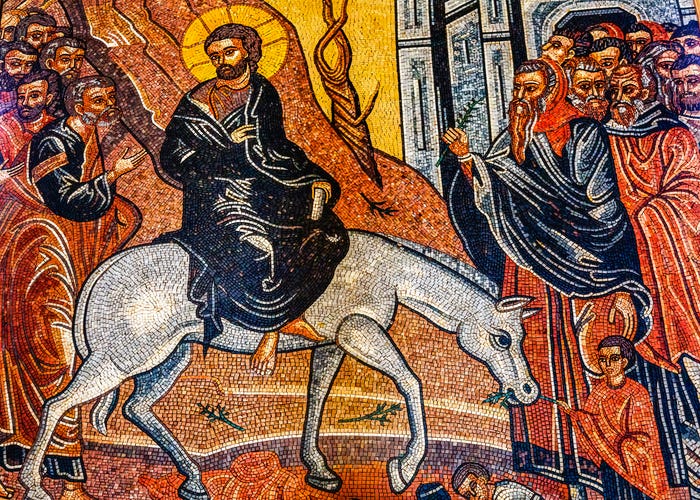
Save us from sin and injustice. Save us from war and violence. Save us from those who rule in their name—Donald Trump, Benjamin Netanyahu, the new Ayatollah, and Vladimir Putin.
On Palm Sunday, the crowd was clear about what it wanted. They called out to be saved from Herod and Rome, from corruption and military rule, from death and crucifixion, and from betrayal and denial. Hosanna in the highest. Save us now. Restore what we have lost, remove what oppresses us, and finally set things right.
People have always longed for a savior, from the crowds shouting “Hosanna” under Roman rule to today’s Silicon Valley engineers who promise to defeat death. On Palm Sunday, the crowd greeted Jesus with a word that means “Help us,” a plea hidden in praise, calling him their long-awaited king. They laid down cloaks and branches for a ruler. But within a week, many turned against him because he was not the savior they expected.
Today, this longing appears in different forms. Some billionaires promise to create a virtual afterlife and build a transhuman future. They receive praise through government contracts, public interest, and growing trust in technology over people. The details have changed, but the basic desire is the same. We still want to be saved on our terms.
We praise the savior we want and reject the one we get; AI becomes a demon or a demigod—so do our leaders.
“No Kings” reverberates again this weekend—today’s “Hosanna.” Jesus recedes. Other leaders take his place. Loyalties shift. After a revolution, passionate liberals often become guardians of the status quo, even conservatives.
If Jesus had been the king people wanted, Rome might have fallen, but another Rome would likely have taken its place. Even democracy can give rise to its opposite as authoritarians learn to use its language and claim its name.
Jesus speaks of the kingdom of God, which is not about a harsh ruler in heaven or a perfect system run by experts. Instead, it is a way of life that challenges power and changes things from the ground up. In the Bible, Gideon’s army is made small so victory will not be mistaken for human strength. Paul, the chief apostle, describes his own suffering by saying, “When I am weak, then I am strong.”
No glorification of victimhood or today’s buzzword “vulnerability”; this speaks instead of strength without display, power without domination, and life that does not depend on winning.
Henry Kissinger asked peace activist and Yale chaplain William Sloane Coffin, “What kind of foreign policy is that?” Coffin answered, “Justice is not a policy. Peace is not a program. They are what policy is supposed to serve, not what it replaces.”
Archbishop Desmond Tutu faced public outrage and, at times, even made Nelson Mandela uneasy in how he led the Truth and Reconciliation Commission. After years of brutal apartheid, he insisted that the country’s future could not be built on denial or revenge. “Without forgiveness there is no future,” he said, urging both victims and perpetrators to tell the whole truth.
Tutu did not take the stage. He refused the easy authority of applause. He used his influence to say: Let those who have harmed others speak honestly. Let what is hidden come into the open. Then we will see if forgiveness can last.
The Commission listened to hundreds of stories, usually without talk of revenge but always with a sense of moral seriousness. Amnesty was given for full honesty, not as an excuse but as a risk for a shared future.
Some who confessed later stood with the new South Africa they had once opposed. The process did not settle every account. It did something harder: it refused to let justice and reconciliation cancel each other out.
And so the cry remains. Not a slogan, not a program, but a plea we do not outgrow. Hosanna still means “Save us.” The question is not whether we will ask it, but what we expect in reply and whether we will recognize the answer when it comes.
Notes and reading
Donkey Mosaic—Madaba is an ancient town in Jordan, southwest of Amman, best known for the 6th-century mosaic map of the Holy Land preserved in the Church of St. George.
Palm Sunday—Matthew 21:1–11 (Mark 11:1–11; Luke 19:29–44; John 12:12–13). In Western usage, the day is often titled “Palm Sunday of the Passion of the Lord” in Roman Catholic and some Protestant traditions. The Passion narrative (Jesus’ arrest, trial, and crucifixion) is read alongside the triumphal entry, holding praise and crucifixion together in a single liturgy—aligning with Desmond Tutu’s insistence that truth and reconciliation must be faced together, not one after the other.
(Passover—falling just after Palm Sunday. The Jewish commemoration of the Israelites’ exodus from Egypt, from slavery to freedom. Christians have often drawn on its themes in their observance of Easter, while the traditions remain distinct. The following day in 1968, Martin Luther King Jr. delivered his final public address, now known as the “I’ve Been to the Mountaintop” speech.)
No Future Without Forgiveness—Desmond Tutu (2000). Tutu’s most revealing and essential book. It shows him at the decisive moment of his life—chairing South Africa’s Truth and Reconciliation Commission.
God Has a Dream: A Vision of Hope for Our Time—Tutu (2004). A distilled statement of his vision.
Make Your Home in This Luminous Dark: Mysticism, Art, and the Path of Unknowing—James K.A. Smith (2026). Faith lived without certainty. Used here to clarify “Hosanna” as an ongoing plea, not a program.
Confessions of the Antichrist (A Novel)—Addison Hodges Hart (2020). A literary warning about confusing worldly power with salvation—the temptation behind “Hosanna,” and the urge to make the gospel straightforward, practical, and believable.
You go deeply into the mixed messages we often send through our perennial plea of "Hosanna." The ambivalence of its message--captured in the rock opera of my youth as "Hey JC, JC, won't you fight for me? / Sanna ho, Sanna hey, Superstar"--seems inconsistent with our calling as the "body of Messiah," Paul's "filling up" of Messiah's sufferings as they would apply here and now.
I learned a lot here about Tutu's approach to the Truth and Reconciliation Commission. I love your expression "the easy authority of applause," which sounds like something from a Martin Luther King speech. I also loved this observation--both its substance and expression: "Amnesty was given for full honesty, not as an excuse but as a risk for a shared future." Your chosen example here of forgiveness as a means of moving forward connects so nicely with where Palm Sunday's hosannahs and Good Friday's "Father, forgive them"--taken together--point. As you remind me, the Passion narrative beginning with Jesus riding into Jerusalem holds "praise and crucifixion together in a single liturgy."
Thanks for your generous response, Bryce! Very encouraging.