
Radical Prudence
O God, give us the urgency of those who love, and the patience of those who are loved.

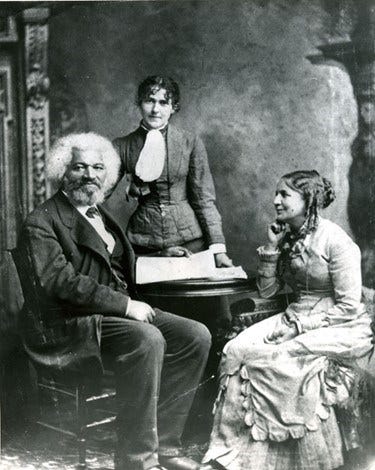
These days, when outrage makes sense, prudence can feel old-fashioned. After recent White House decisions, moderation is hard to believe. Yet two unlikely figures—a radical hero and a conservative icon—both have something to say. By “radical,” in this reflection, I don’t mean extreme but rooted: going to the root of what deciding well requires. In Douglass and Burke, prudence means judgment, not just moderation.
Liberal democracy is under real pressure. The hope that followed the fall of the Iron Curtain in 1989 has faded. Alliances are fraying, conflicts multiplying, and civic trust eroding. Much of this decline is driven by populist movements that treat civil rights as problems instead of progress.
This affects everyone. Liberal democracy lasts only if all sides respect its institutions. When conservatives defend democratic norms, those norms survive. When they stop, democracy weakens.
To Edmund Burke, prudence was the highest political virtue; to Russell Kirk, a leading conservative thinker today, it was the soul of conservatism. Today, we see the cost of its absence. Without prudence, democracy loses its balance. We fall into the trap Burke feared most: a fractured state where moderation is mocked as weakness and compromise is seen as betrayal.
The chaos of the 2026 political season has made prudence seem even less important. Winning at any cost now passes for strength. Victory is the only rule left. Beating the other side at its own game becomes the strategy. “When in doubt, raise your voice.” Respecting limits no longer appeals, though it once helped conservatives keep order without becoming authoritarian and helped liberals avoid turning reform into bureaucracy.
Frederick Douglass shows this in human terms. More than any other Black leader of his time, he made sure Abraham Lincoln recognized his moral authority. He helped Black Americans prepare for civic life and urged white Americans to accept a new political order. Though a fierce speaker who rarely backed down, Douglass later admitted his urgency sometimes blinded him to what leadership required.
At first, Douglass thought Lincoln was moving too slowly. Over time, he saw that Lincoln’s restraint was a sign of judgment and faith, not weakness. Lincoln wanted to protect the fragile constitutional system so that freedom and justice would endure.
Douglass saw that even just causes fail if they blame more than they persuade. Anger, however justified, can deepen the injustice it opposes. The goal was to end slavery, not to perform outrage. He urged abolitionists to stay engaged with the system they despised, because only from within could they change it.
Although Burke would seem the opposite of Douglass, he might have recognized in Douglass a moral radical who knew the difference between restraint and giving in. Burke defended the American Revolution and supported reform. He opposed change that ignored context and consent.
In Lincoln, Douglass saw what Burke valued most: a drive for lasting good, and a patience that was not passive.
Our political divisions could narrow if each side were truer to its history. Liberals admire Douglass for his righteous anger but often forget how hard he worked to turn anger into persuasion. Conservatives respect Burke for defending order, but often overlook how much he valued reform. Each tradition hollows out when it forgets its own inheritance. Democracy is stronger when reform includes restraint, and restraint is open to reform.
Recovery starts locally, in meetings where people care about what comes next. Moving past recurring crises means valuing the work of these meetings as much as the strength of our arguments. Productive disagreement does not erase differences; it changes how we see them. “I hadn’t thought of it that way before” is often the first sign of better judgment.
Douglass understood this. He once said:
“I would unite with anybody to do right and with nobody to do wrong.”
For Douglass, agreement was about ethics, not just feelings, and about principle, not only strategy. He trained as a preacher, spoke like a prophet, and became a public thinker because he had to. His conviction was contagious, and he prayed with confidence. We could do the same.
Save us, O Lord, from softness and sentimentality. Give us victory over our moods, magnanimity before life’s limits, and strength to accept the self-denials our hopes and aspirations demand. Make splendid the vision of what we may yet be, and what you intend for your world.
Amen.
Notes and reading
“prudence”—from Latin prudentia (“foresight,” “practical wisdom”), shortened from providentia (“providence”). Its core sense is “seeing ahead,” hence its association with careful judgment and the anticipation of consequences.
Aristotle—The best treatment of prudence (phronēsis) is in the Nicomachean Ethics, Book VI, especially chapter 5 (1140a24–1140b30).
Narrative of the Life of Frederick Douglass, An American Slave (175th Anniversary Edition, 2020). A foundational account of moral urgency disciplined by political intelligence.
Measuring the Man: The Writings of Frederick Douglass on Abraham Lincoln, ed. Lucas E. Morel and Jonathan W. White (2025). Documents Douglass’s transition from righteous indignation to the recognition of Lincoln’s constitutional prudence.
“Personal Responsibility Under Dictatorship”—Hannah Arendt (1964). Arendt rejects the “cog in the machine” excuse: resistance came not from better “values” but from thinking for oneself. Without judgment, morality becomes dangerous—and no cause redeems it. (essay online at WordPress.com)
“Burke’s Revolutionary Reflection”—Dominic Green, The New Criterion (January 2026). Reassesses Burke’s reformism as a defense of order against zeal. A second essay, “Conceived in Liberty,” highlights Burke’s moral culture but makes prudence partisan.
“Eulogy for Abraham Lincoln”—Frederick Douglass, Cooper Union (1865). A complex tribute acknowledging Lincoln as both the “white man’s President” and the martyr whose restraint made freedom possible. (essay online at loa.org)
Speaking Out To Strengthen the Guardrails of Democracy—Divided Community Project, OSU Moritz College of Law Program on Dispute Resolution (2023). A 45-page guide with contributions from leaders, scholars, and practitioners. (online at moritzlaw.osu.edu/)
[Prayer - inspired by Joseph Ferguson King, former senior pastor, First Church, Oberlin.]
See also Offensive Blessing - Tip-Off #170
“We are not all in the same boat. We are in the same storm.”