
89 seconds
A snow-day reflection on the time that remains.

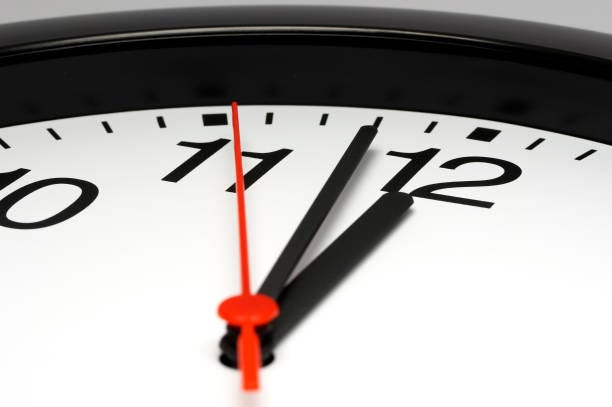
In December 1945, after Hiroshima and Nagasaki, scientists who had helped build the atomic bomb founded the Bulletin of the Atomic Scientists. They worried that once the shock faded, denial would return, and responsibility recede. The Doomsday Clock is its most recognized symbol.
In 1991, the clock was set seventeen minutes from midnight. By 2025, it moved to eighty-nine seconds, reflecting nuclear risk, climate instability, and artificial intelligence.
“The end is near.” This kind of apocalyptic thinking has been around for a long time. Frank Kermode, in The Sense of an Ending (1967), argued that apocalyptic narratives impose formal coherence—beginning, middle, end—on historical chaos. We don’t like feeling stuck in history, so we look for a climax, even though these stories may not help when disaster seems certain.
Climate politics now faces this challenge. Some argue that doom discourages action, while others advocate acting on principle regardless of success. The main difficulty is scale. The crisis is global and overwhelming, while our ability to act feels small and personal.
David Bentley Hart reminds us that “apocalypse” literally means an unveiling, a disclosure of truth rather than a spectacular ending. We err when we mistake the destruction of the world for its meaning. Hart asks if our politics can handle that honesty.
If an apocalypse is about seeing truth clearly, what do we need to keep our eyes open? Long before scientists measured seconds to midnight, Jesus told a story about this readiness.
The Parable of the Ten Bridesmaids describes ten women waiting for a bridegroom at night. Five bring extra oil; five do not. When the bridegroom arrives late, the unprepared are excluded. The story concludes, “Keep awake, for you know neither the day nor the hour.” Readiness cannot be borrowed, improvised, or delegated.
In The Denial of Death, Ernest Becker contended that civilization, despite its achievements, is fundamentally a project of denial, where the capacity to defer crisis is mistaken for the wisdom to resolve it. The Doomsday Clock disrupts this illusion by compelling society to confront uncomfortable realities. Genuine readiness begins only when denial ceases.
Much of today’s political disorder stems from refusing to begin that work. Culture wars and spectacle are easier than facing the risk of not leaving a livable world. Even the best leaders cannot act alone. The prepared bridesmaids did not need to be heroes; they simply made sure they had oil before they fell asleep.
Today, “oil” is a volatile symbol. In geopolitics, it is the fuel of rivalry. In the parable, oil represents the quiet prudence to keep a lamp burning. For Becker, this “oil” is the courage to face reality without illusion, the refusal to mistake the exercise of power for a lasting resolution.
Scientists warn about both technology and rigid idealism. Enemies may be demonized one day and accepted the next as alliances shift, but the dangers persist. Preparedness cannot be borrowed, whether the threat is moral or material.
Consider the “prevention paradox” of Y2K. Governments spent billions to fix computer systems before the year 2000. When the lights stayed on, many dismissed the warnings as hysteria, overlooking that preparation prevented the catastrophe. In the work of readiness, success often looks like a false alarm.
The Doomsday Clock is a warning, not a script. Helplessness is not a scientific conclusion; it is a political mood that ineffective leadership depends on. When we believe the future is predetermined by fate or technology, we stop preparing, and power remains unchallenged.
Pessimism is not fatalism, and cynicism is not realism. Cynicism is pessimism stripped of duty—an alibi for inaction. But appeals to duty will fail if they don’t acknowledge the skepticism we all feel.
The greatest danger is not inevitable collapse, but believing it is. Accepting “the end” is psychologically easier than staying prepared. The parable offers no excuses: it gives neither warrant for despair nor a guarantee of rescue—only the task of having enough oil. Sufficiency is the point.
It’s almost midnight. The real question now isn’t just where the clock’s hands are, but whether our lamps are still burning. If they are, it means we’ve stopped hiding and started doing the work to be ready. In the end, what matters is how we use the time that remains.
Notes and reading
Learning from Martin Luther King Jr.’s acknowledged mistake during the Albany Movement in Georgia (1961–1962).
King acknowledged a strategic failure: protesting segregation in general rather than confronting a single, concrete injustice. “Our protest was so vague that we got nothing, and the people were left very depressed and in despair…. It would have been much better to have concentrated on integrating the buses or the lunch counters. One victory of this kind would have been symbolic, would have galvanized support and boosted morale.”
The lesson bears directly on apocalyptic politics. When danger is framed as total and abstract, paralysis follows. Readiness begins instead with focused, winnable acts: restoring enforceable nuclear arms limits rather than condemning nuclear weapons in the abstract; reinforcing specific climate infrastructure rather than invoking planetary collapse; imposing clear accountability on a defined high-risk technology rather than warning vaguely about “AI.” As King understood, symbolic victories are not evasions of reality—they are how responsibility becomes actionable.
- Martin Luther King Jr., Where Do We Go from Here: Chaos or Community? (1967) and Why We Can’t Wait (1964). See also “Making a Difference: Martin Luther King Day, January 19,” previous post.
“Activist Witnessing,” “The Attraction of Truth”—Robert Jay Lifton, Surviving Our Catastrophes (rev. ed. 2025), chapter 6-Epilogue. Lifton—psychiatrist and historian known for foundational work on psychological survival, nuclear trauma, and moral responsibility in the atomic age.
Hopeful Pessimism—Maria van der Lugt (2025). Van der Lugt—political theorist writing on pessimism, realism, and moral agency under conditions of crisis and uncertainty.
Why We Are Obsessed with the End of the World—Dorian Lynskey (2025). Lynskey—cultural journalist and critic examining apocalyptic imagination across politics, media, and popular culture.
“Doomsday Clock?”—Emily Strasser, Popular Mechanics (January/February 2026). Strasser—science and technology journalist covering risk, innovation, and the cultural meaning of scientific warning systems. She is the granddaughter of George Strasser, who helped build the atomic bomb.
The Denial of Death—Ernest Becker (2007). Becker—cultural anthropologist whose work explores how societies manage mortality, fear, and denial through symbolic systems.
On apocalypse as unveiling, see David Bentley Hart, The New Testament: A Translation (Second edition 2023) and related theological essays, where Hart emphasizes that apokalypsis names disclosure rather than catastrophe.
Parable of the Ten Bridesmaids—Matthew 25:1-13.
I love how you use the parable of the ten bridesmaids to carve out a space (or a time, if you will) between endless time and the end of time. Jesus seems to carve out that same space by telling us that the bridegroom is late. I had never thought about that before.
We want to measure the time until the end. We resonate with clocks and the eventual strike of the midnight hour when all clocks, and the time they measure, will be no more. But the bridegroom comes at a very different midnight, one that can’t be found on a clock’s face. Our anticipation of the bridegroom creates this time that remains.
Giorgio Agamben seems to carve out a similar space in his book The Time That Remains, though he focuses mostly on Paul’s very similar understanding of time: “What interests the apostle is not the last day, it is not the instant in which time ends, but the time that contracts itself and begins to end (ho kairos synestalmenos estin; 1 Cor. 7:29), or if you prefer, the time that remains between time and its end” (62).
These distinctions of time are somehow heartening. Agamben, of course, isn’t the first to understand our time in terms of a messianic overlap of ages.
The idea that the bridegroom is late no longer threatens to overturn my faith, a threat that I think drove Schweitzer’s Paul to institute some changes in church practice. Instead, the time “while the groom was delaying” (NAS) represents an active hope. Get the oil now: we’ll need the lamps then!
This reckoning of time in terms of a delay—even this search for the right language for that reckoning—is playful, almost Churchillian. I’ve always found his remarks after the Battle of Egypt as oddly inspiring: “Now this is not the end. It is not even the beginning of the end. But it is, perhaps, the end of the beginning.”
It is interesting to note that you refer to the book The Denial of Death. Such denial is at the root of Western culture altogether.
These references describe the situation.
http://www.easydeathbook.com/purpose.asp
http://beezone.com/adida/easydeath/deathisnotyourconcern.html
http://beezone.com/latest/death_message.html Death as the Constant Message of Life http://beezone.com/whats-new
http://www.adidaupclose.org/death_and_dying/index.html